Messier 35 (M35)
Also Known as: NGC 2168, Collinder 82
Object Type: Open Cluster
Constellation: Gemini
Distance from Earth: 2,800 light years
Apparent Magnitude: 5.3
Coordinates: RA 06H 09.1M 0S DEC 24 deg 21 min 0 sec
Actual Size: 24 light years in diameter
Apparent Dimensions: 28 arc-minutes
Discovered by: M35 was discovered by Jean-Philippe Loys de Cheseaux in 1750 and independently discovered by John Bevis in the same year.
Charles Messier included the open cluster in his catalogue on August 30, 1764.
Description: Messier 35 (M35) is a large open star cluster located in the northern constellation Gemini.
The cluster consists of several hundred stars, of which 120 are brighter than magnitude 13. The central region has a density of 6.21 stars per cubic parsec. It is the only Messier object in Gemini.
The estimated age of M35 is about 110 million years. The hottest main sequence stars in the cluster have the spectral classification B3.
M35 also contains more evolved stars, including several orange and yellow giants. The cluster is approaching us a 5 km/s.
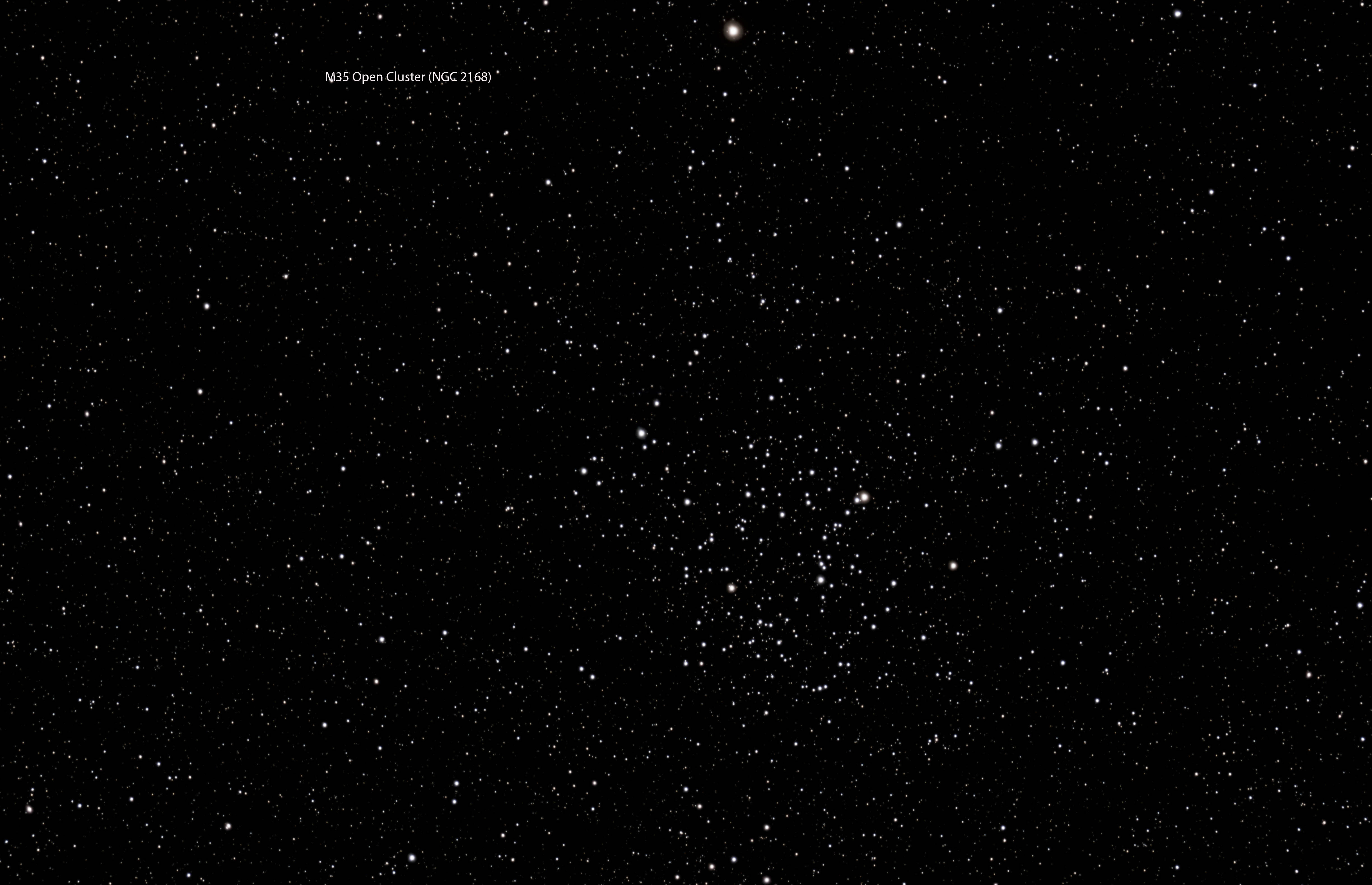
Messier 35 occupies an area of 28 arc minutes on the sky, which is roughly equal to the size of the full Moon. The cluster has a true diameter of about 24 light years.
The region within the central 3.75 parsecs of the cluster has an estimated mass between 1,600 and 3,200 times solar.
M35 has the Trumpler classification III 3 r, which means that it is detached from the surrounding star field with no noticeable concentration (III), that it contains both bright and faint stars (3) and that it is richly populated (r), with more than 100 stars.
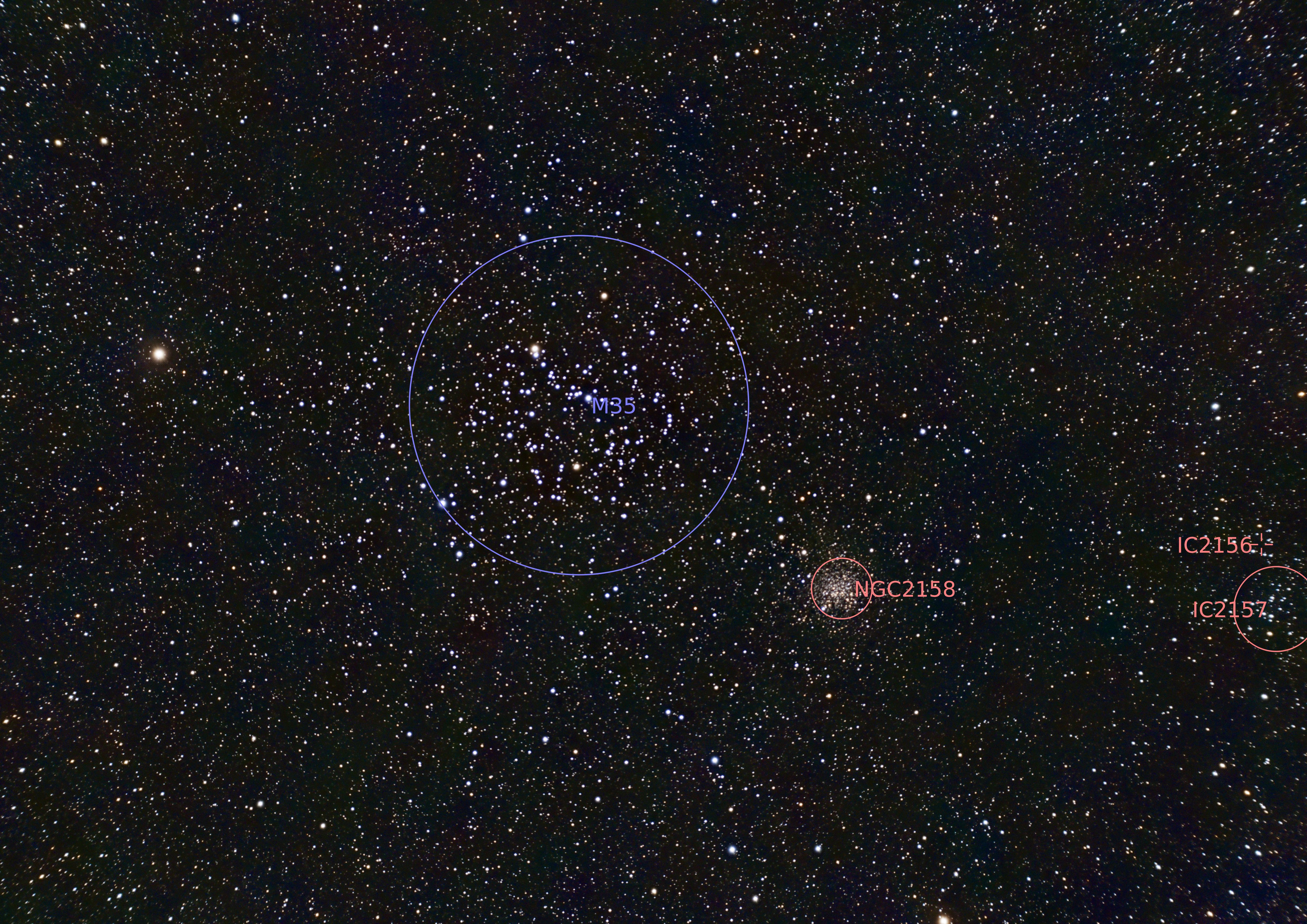
A similar but less populated cluster, NGC 2158 can be found 50 arc-minutes West of M35. NGC 2158 has an apparent magnitude of 8.4.
Click Below Image(s) for Full Size:
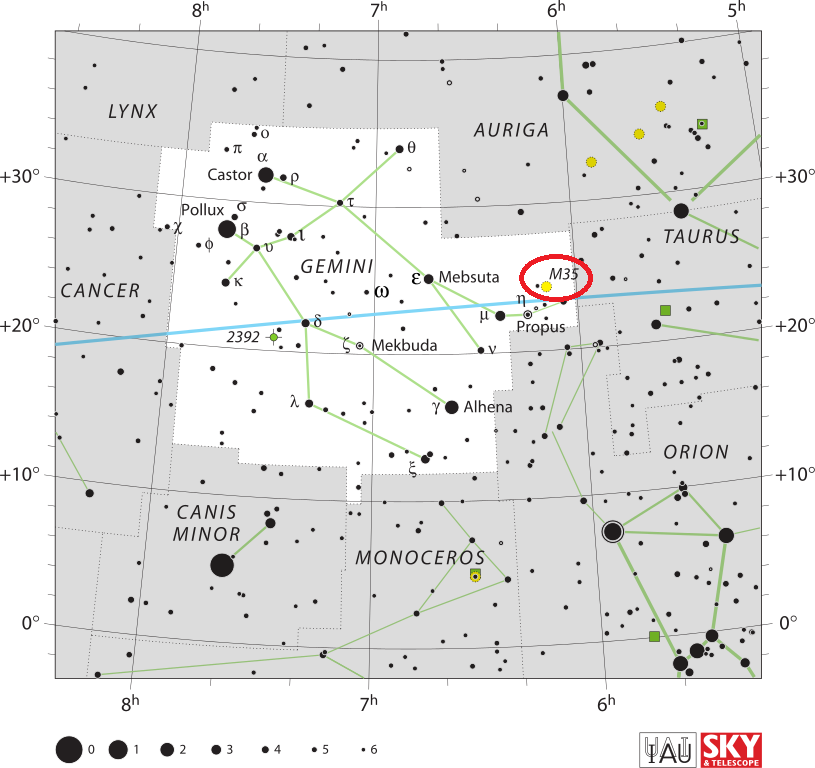
The brightest stars in M35 can be easily resolved with 10 x 50 binoculars. It is so large that it is roughly the size of the full Moon.
Small telescopes can resolve the fainter stars while a 6 to 8 inch scope at low magnification shows a field full of stars.
The best time to view M35 is in the winter months.
Platesolve
M35 Open Cluster
Imaging Details
M35 Open Cluster
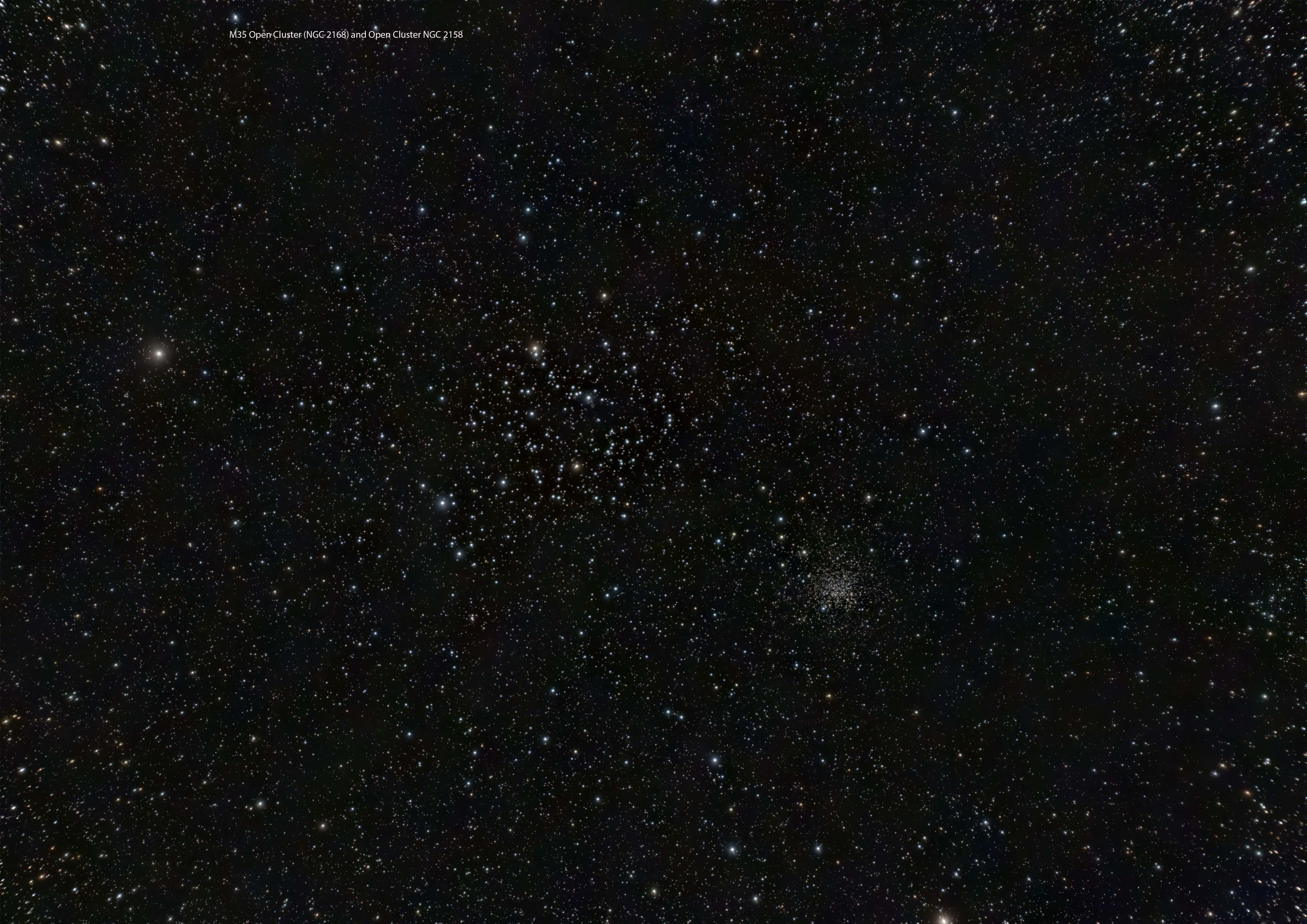
Imaging Details
Click to Return to Home Page