Messier 33 (M33)
Common Name: Triangulum Galaxy
Also Known as: NGC 598, Triangulum Pinwheel.
Object Type: Un-barred Spiral Galaxy
Constellation: Triangulum
Distance from Earth: 2.38 to 3.07 million light years
Apparent Magnitude: 5.72
Coordinates: RA 01H 33M 50.02S DEC 30 deg 39 min 36.7 sec
Actual Size: 60,000 light years in diameter
Apparent Dimensions: 70.8 arc-minutes x 41.7 arc-minutes
Discovered by: Messier 33 was probably first discovered by the Italian astronomer Giovanni Battista Hodierna before 1654.
Hodierna listed the object as a cloud-like nebulosity near “the Triangle” in his work De systemate orbis cometici; deque admirandis coeli caracteribus (“About the systematics of the cometary orbit, and about the admirable objects of the sky”).
Charles Messier found the object independently and catalogued it on August 25, 1764.
Description: Messier 33 is sometimes known as the Triangulum Pinwheel or Pinwheel Galaxy, a name commonly used for Messier 101, another famous face-on spiral galaxy, located in the constellation Ursa Major.
M33 got its name from the area of the sky it occupies, the constellation Triangulum. Triangulum is Latin for “triangle” and refers to the asterism formed by the constellation’s three brightest stars, Ras al Muthallah (Mothallah) or Alpha Trianguli, Deltotum or Beta Trianguli, and Gamma Trianguli.
The three stars form a long, narrow triangle, with Alpha Trianguli marking the apex and Beta and Gamma Trianguli at the base.
M33 is the 3rd largest galaxy in our Local Group of Galaxies after the Andromeda Galaxy and our Milky Way galaxy.
It has a mass of between 10 and 40 billion solar masses which is significantly less than the Andromeda Galaxy or the Milky Way Galaxy.
Messier 33 is believed to be a satellite of the larger Messier 31 based on their proximity, interaction and velocities. The two galaxies are separated by less than 300 kiloparsecs.
M33 is slightly more distant from us than Andromeda. A stream of hydrogen gas linking M31 and M33 was discovered in 2004 and confirmed in 2011, indicating a past interaction between our two neighbors between 2 and 8 billion years ago.
M33 and M31 will likely undergo a more dramatic encounter in about 2.5 billion years.
It may be absorbed by the Andromeda Galaxy or be ejected out of the local group of galaxies.
The future of the Triangulum Galaxy cannot be predicted with any certainty, but it is tied to that of the Andromeda Galaxy.
M33 will either be absorbed by Andromeda, be part of Andromeda‘s collision with the Milky Way, collide with the Milky Way itself before Andromeda does, or be ejected out of the Local Group of galaxies.
The Triangulum Galaxy is currently approaching the solar system at 179 km/s and the Milky Way Galaxy at 24 km/s.
Click Below Image(s) for Full Size:
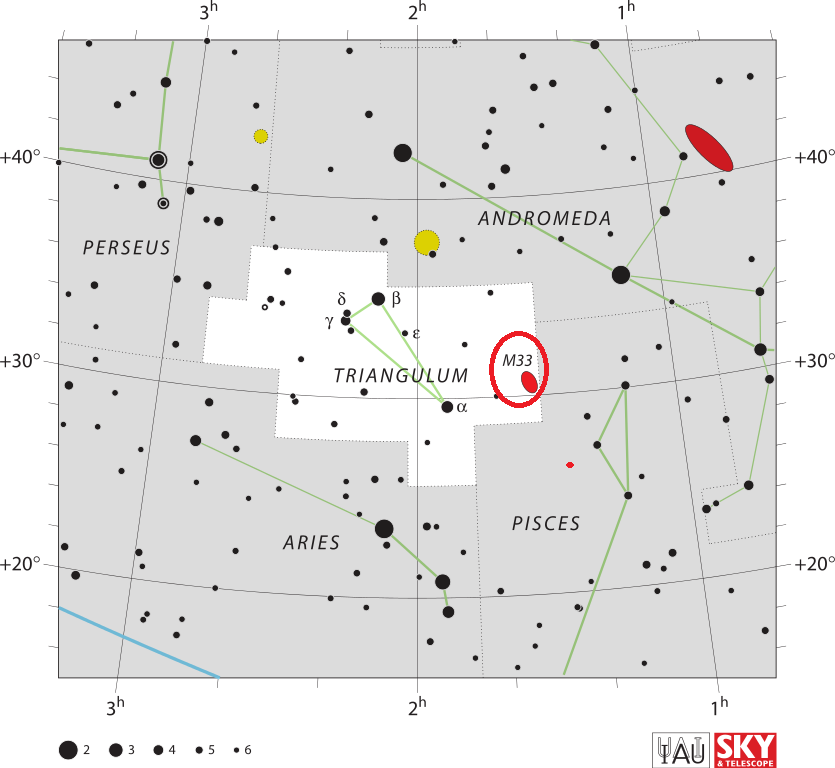
M33 is one of the most distant deep space objects visible to the un-aided eye.
Messier 33 appears face-on when viewed from Earth and has a low surface brightness.
It is strongly affected by light pollution and can be a challenge for observers – with or without binoculars or telescopes – in less than perfect conditions.
The Triangulum Galaxy is best seen in very large binoculars or telescopes at low magnifications.
It is a popular target for astrophotographers as its spiral arms and brighter H II regions can be captured with better amateur equipment.
Large telescopes will reveal the galaxy’s globular clusters, dust lanes and spiral structure itself.
It is best seen with large binoculars at low magnification and is a popular target for amateur Astro photographers.
The best time to view M33 is October-December
Platesolve
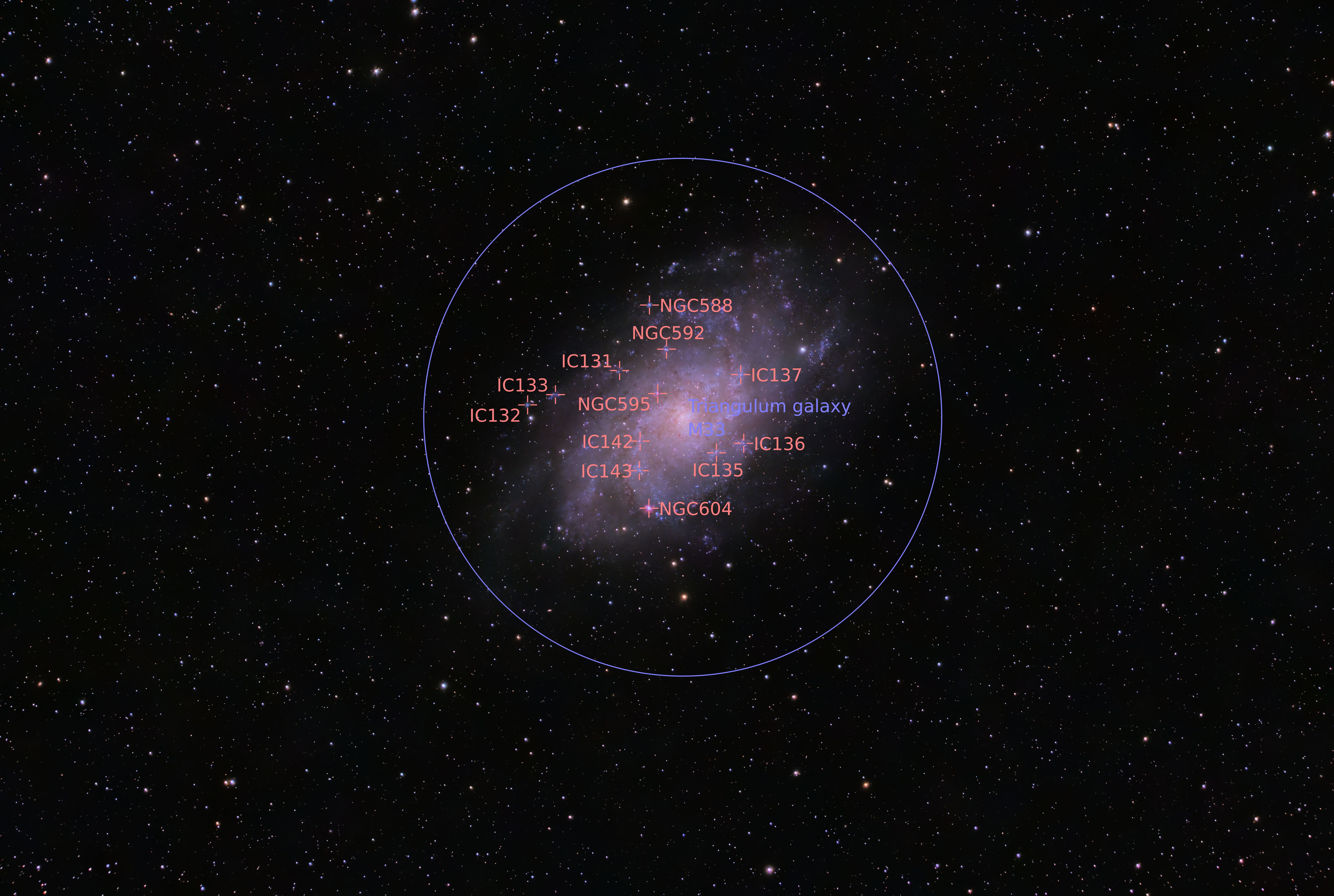
M33 Spiral Galaxy

Imaging Details
Click to Return to Home Page