Messier 109 (M109)
Also Known as: NGC 3992
Object Type: Barred Spiral Galaxy
Constellation: Ursa Major
Distance from Earth: 83.5 million light years
Apparent Magnitude: 10.6
Coordinates: RA 11H 57M 36.0S DEC 53 deg 22 min 28 sec
Actual Size: 90,000 light years in diameter
Apparent Dimensions: 7.6 arc-minutes x 4.7 arc-seconds
Discovered by: M 109 was probably discovered by Charles Messier in the spring of 1781 while checking the position of two objects discovered by Pierre Méchain,
who had found three objects in this region of the sky.
Messier only determined the position for M97, the Owl Nebula, and mentioned the other two in his description.
He added M109 to his personal copy of the catalogue in 1783, describing it as a “nebula near Gamma UMa, same right ascension a bit near this star and 1 deg… more south.
Discovered by M. Méchain on March 12, 1781.”
Description: M109 contains an estimate 1 trillion stars.
It is the brightest member of the M109 group of 79 galaxies in Ursa Major.
It has 3 known satellite galaxies: UGC 6923, UGC 6940, and UGC 6060 and possibly more.
M109 is by far the most distant object in the Messier Catalog, followed by M91.
Click Below Image(s) for Full Size:
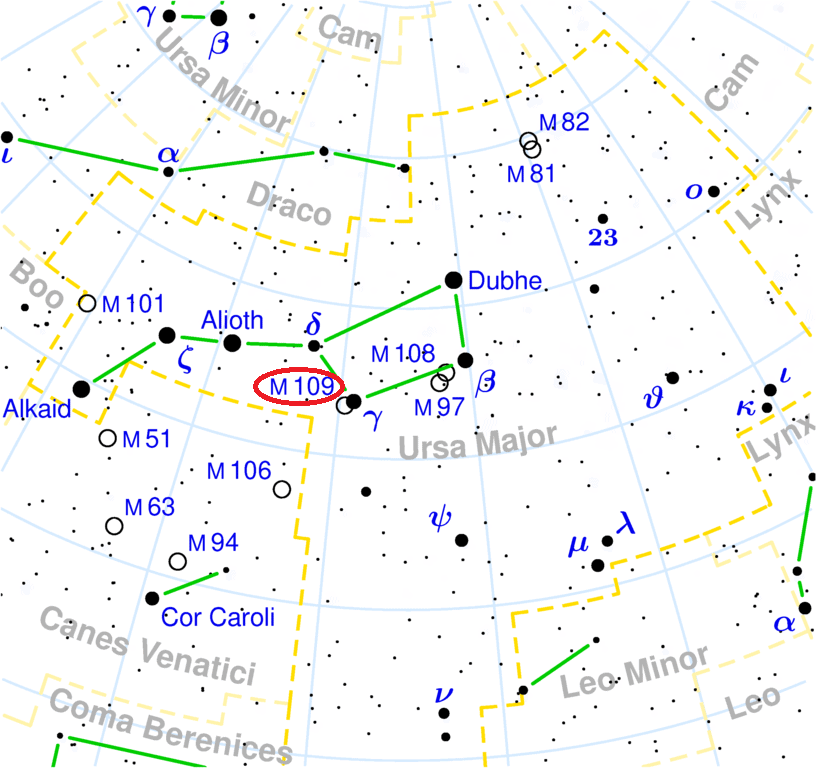
M109 can be seen with large binoculars under good conditions.
A 4-inch scope shows a hazy streak of light while a 6-inch scope reveals the galaxy’s nucleus surrounded by nebulosity.
Only the galaxy’s bright central region can be seen visually.
The best time to view M109 is during the spring months.
Platesolve
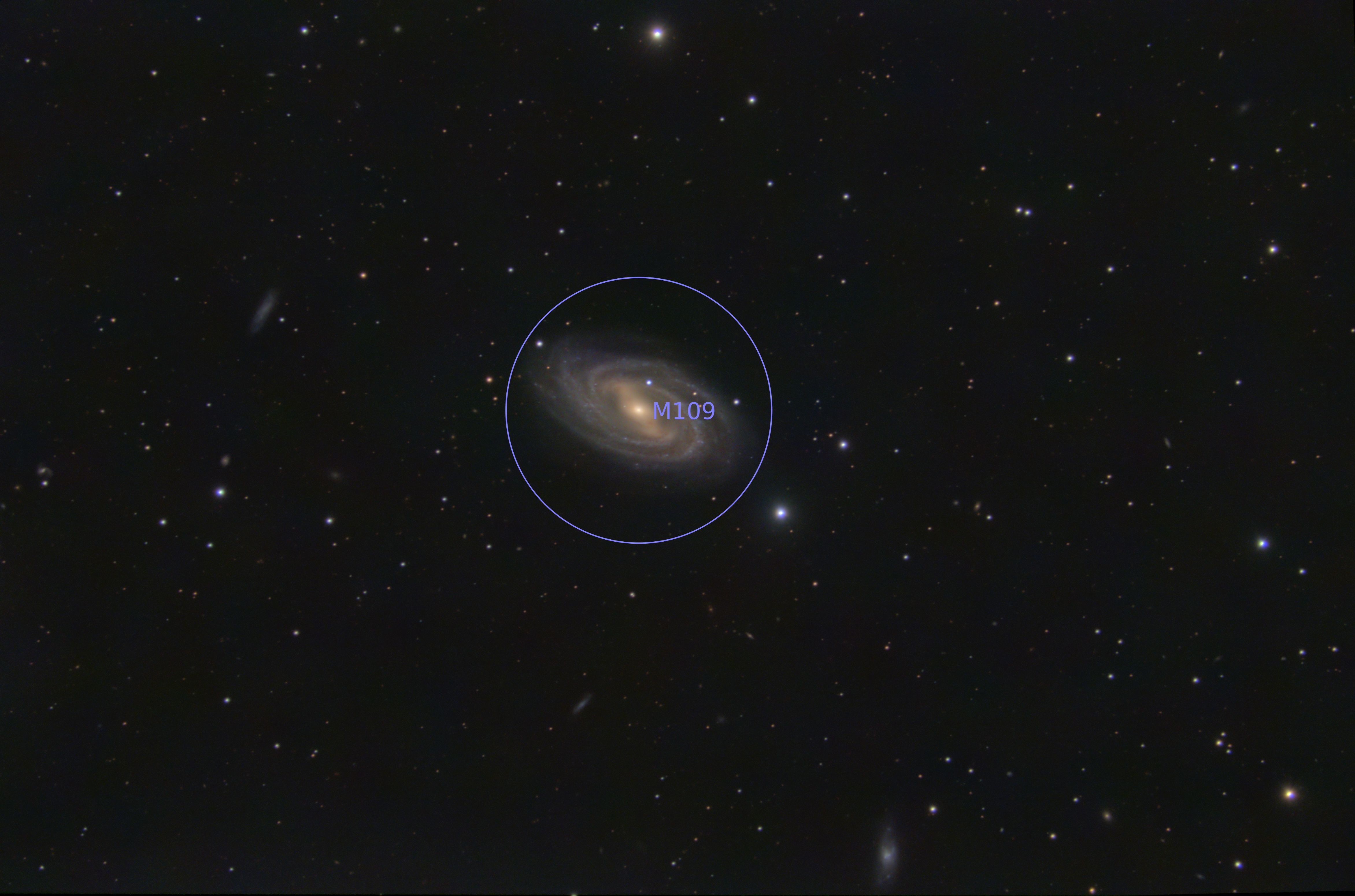
M109 Spiral Galaxy

Imaging Details
Click to Return to Home Page