Messier 108 (M108)
Common Name: Surfboard Galaxy
Also Known as: NGC 3556
Object Type: Barred Spiral Galaxy
Constellation: Ursa Major
Distance from Earth: 45.9 million light years
Apparent Magnitude: 10.7
Coordinates: RA 11H 11M 31.0S DEC 55 deg 40 min 27 sec
Actual Size: 110,000 light years in diameter
Apparent Dimensions: 8.7 arc-minutes x 2.2 arc-seconds
Discovered by: M108 was discovered by the French astronomer Pierre Méchain on February 19, 1781, only three days after he had found the Owl Nebula (M97).
Charles Messier observed both M108 and M109 on March 24, 1781, when he determined the position for M97. However, Messier did not measure the positions of M108 and M109 at the time and only added them to his hand-written list of objects.
He determined the position for both objects much later and included them in his personal copy of the catalogue. He wrote: "Nebula near the preceding… it is even fainter: it is 48 or 49′ further north and 30 min… following in RA:
Found by M. Méchain 2 or 3 days after the preceding [Messier 97]".
Méchain mentioned both M108 and M109 in a letter to Johann Bernoulli dated May 6, 1783. He wrote: "A nebula near Beta in the Great Bear. Mr. Messier mentions, when indicating its position, two others,
which I also have discovered and of which one is close to this one [Messier 108], the other is situated close to Gamma in the Great Bear [Messier 109], but I could not yet determine their positions".
Description: M108 has the morphological classification SBbc, which means that it is a barred spiral galaxy with somewhat loosely wound spiral arms.
The galaxy does not have a pronounced core or bulge, but appears very mottled and dusty, with few H II regions and clusters of young stars.
The dust structures are prominent in the galaxy’s disk and very thick in front of its bulge.
The central region of M108 is bright and irregular, with a large central bar.
M108 is inclined 75 degrees, although it appears almost edge-on.
Dust structures are prominent in the galaxy’s disk.
M108 contains 400 billion stars and is moving away from us at 699 km/s.
The supermassive black hole at M108’s core has an estimated mass of 24 million solar masses.
M108 is one of the brightest, largest member of the Ursa Major Cluster of Galaxies, which is located in the Virgo Supercluster.
M108 is an isolated member of the group. M108 also contains H1 supershells, shells of expanding gas driven either by bursts of star formation and the resulting supernova explosions, or by infall of gas from outside the galaxy, or possibly by radio jets.
The H1 supershells in M108 extend for several kiloparsecs.
Click Below Image(s) for Full Size:
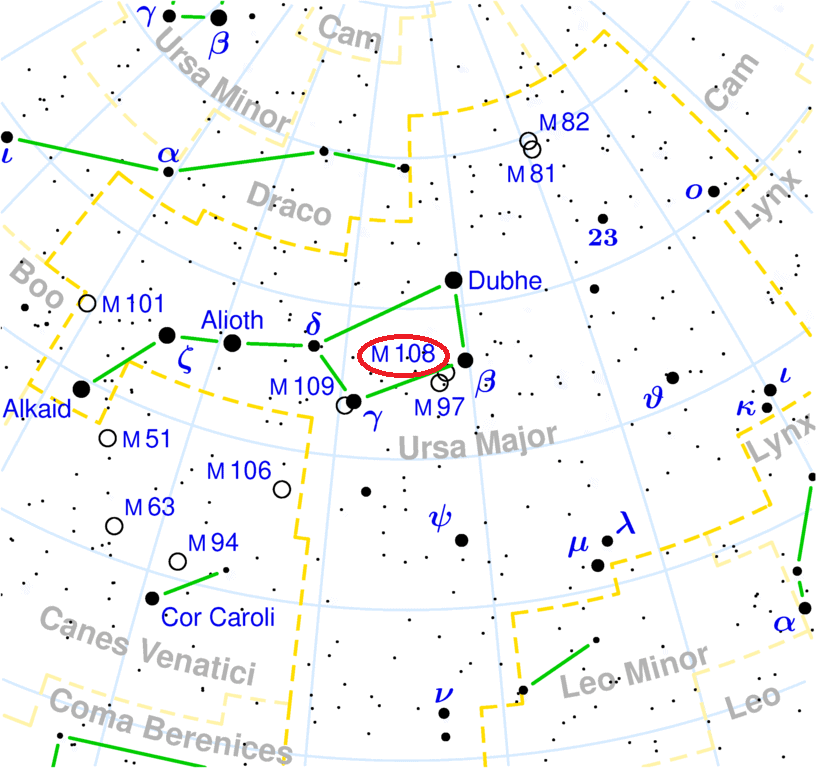
M108 is a popular object since details of its structure can be seen even in amateur telescopes.
The galaxy is easy to find as it lies only 1.5 degrees southeast of the magnitude 2.37 star Merak, Beta Ursae Majoris, one of the Pointer Stars in the Big Dipper.
Its structure can be seen even in amateur telescopes. 3-inch telescopes will only reveal an elongated streak of light with a brighter core, while 8-inch instruments will hint at the galaxy’s dusty regions and bright and faint patches.
The best time of year to observe M108 is during the spring.
Platesolve
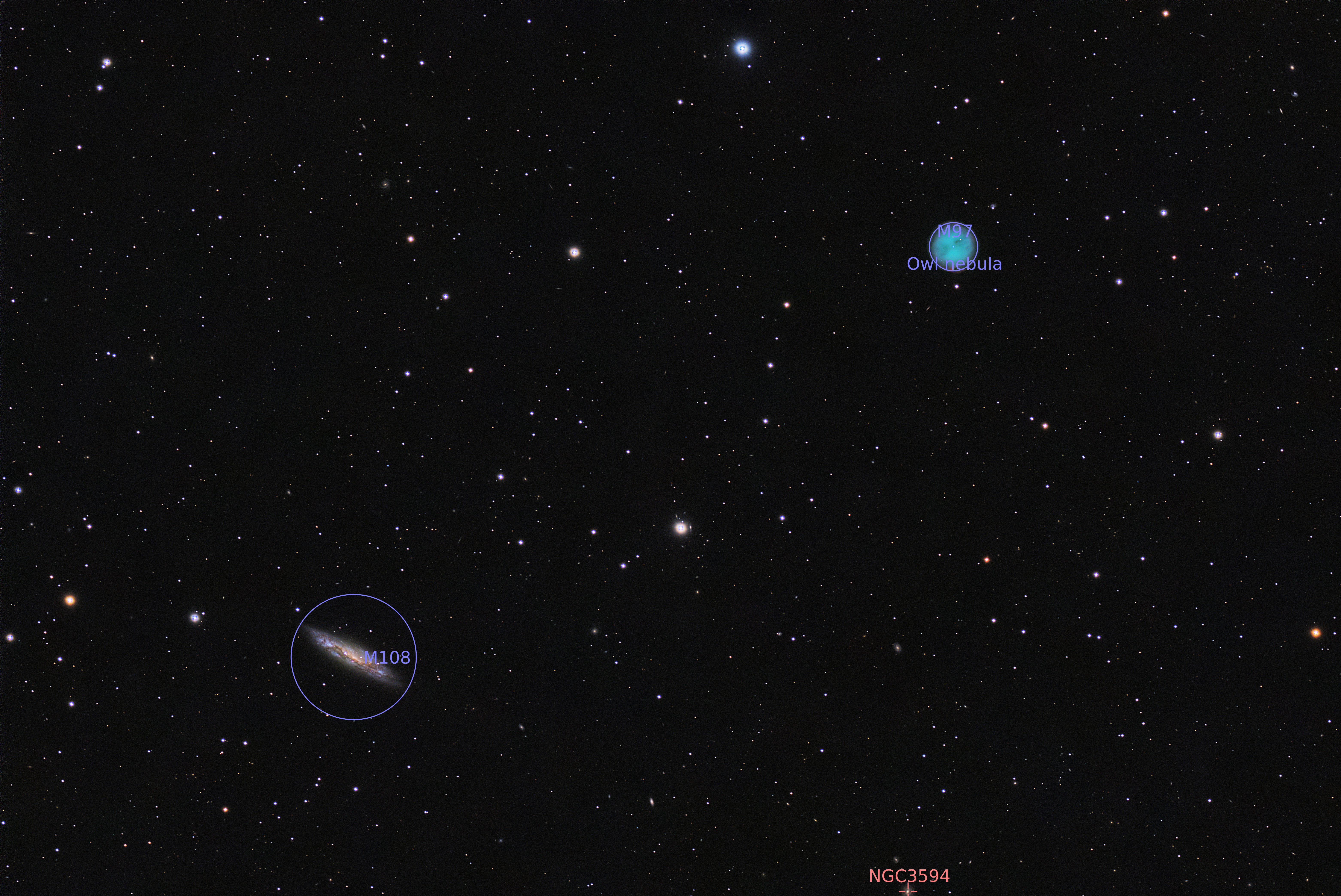
M97 Planetary Nebula and M108 Spiral Galaxy

Imaging Details
Click to Return to Home Page