Messier 105 (M105)
Also Known as: NGC 3379
Object Type: Elliptical Galaxy
Constellation: Leo
Distance from Earth: 32 million Light years
Apparent Magnitude: 10.2
Coordinates: RA 10H 47M 49.6S DEC 12deg 34min 54sec
Actual Size: 55,000 light years in diameter
Apparent Dimensions: 5.4 arc-minutes x 4.8 arc-minutes
Discovered by: Messier 105 was discovered by Charles Messier’s colleague Pierre Méchain on March 24, 1781, only days after he had found the nearby galaxies M95 and M96.
M105 was not included in the original Messier catalogue, but only added to it in 1947 along with M106 and M107, after American-born Canadian astronomer Helen Sawyer Hogg had discovered Méchain’s letter with a description of the object, identified as the galaxy NGC 3379.
Interestingly, Méchain discovered M105 a few days before finding the Pinwheel Galaxy (M101), but M105 was not included in Messier’s final published edition of the catalogue.
Méchain’s letter to Johann Bernoulli, dated May 6, 1783.
Description: Messier 105 is a member of the M96 Group (Leo I Group), a group of galaxies that also includes Messier 95, Messier 96, and at least 21 fainter members.
M105 is the brightest elliptical galaxy in the group. The galaxy is receding from us at 911 km/s.
Two relatively bright galaxies can be seen in the vicinity of M105. NGC 3384, a magnitude 10.9 barred lenticular galaxy, is probably a member of the M96 Group, while NGC 3389, a magnitude 12.4 spiral galaxy, is believed to lie in the background.
Messier 105 and its companion NGC 3384 are surrounded by a vast ring of neutral hydrogen gas.
The ring has a radius of 650,000 light years (200,000 parsecs) and is a site where star forming activity has been detected.
M105 contains a supermassive black hole with an estimated mass between 140 and 200 million solar masses.
The galaxy itself has an estimated mass of about 100 billion solar masses. A few young stars and clusters have been discovered in the galaxy, indicating that new stars do still form in some elliptical galaxies, even if the process is a very slow one, with one Sun-like star formed every 10,000 years on average.
The estimated mass of the ring is about 1.8 billion solar masses.
Click Below Image(s) for Full Size:
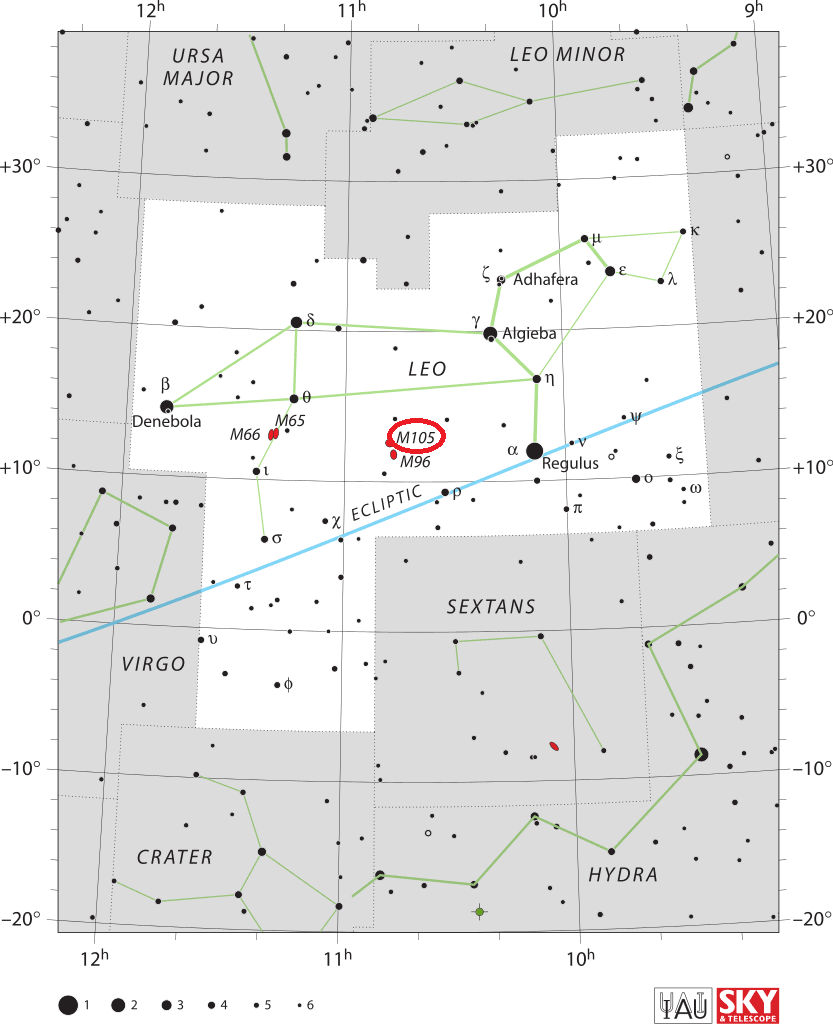
The galaxy is difficult to see in small binoculars and easier to find in large binoculars and small telescopes.
3-inch telescopes show a small, round faint patch of light, while 8-inch telescopes reveal a larger object, but do not show more detail.
Like any other elliptical galaxy, M105 is not particularly impressive to observe because details of its structure cannot be made out in any kind of telescope.
10-inch telescopes will reveal two neighboring galaxies, NGC 3384 and NGC 3389, in the same field of view.
The best time of year to observe the galaxies is during the spring.
Platesolve
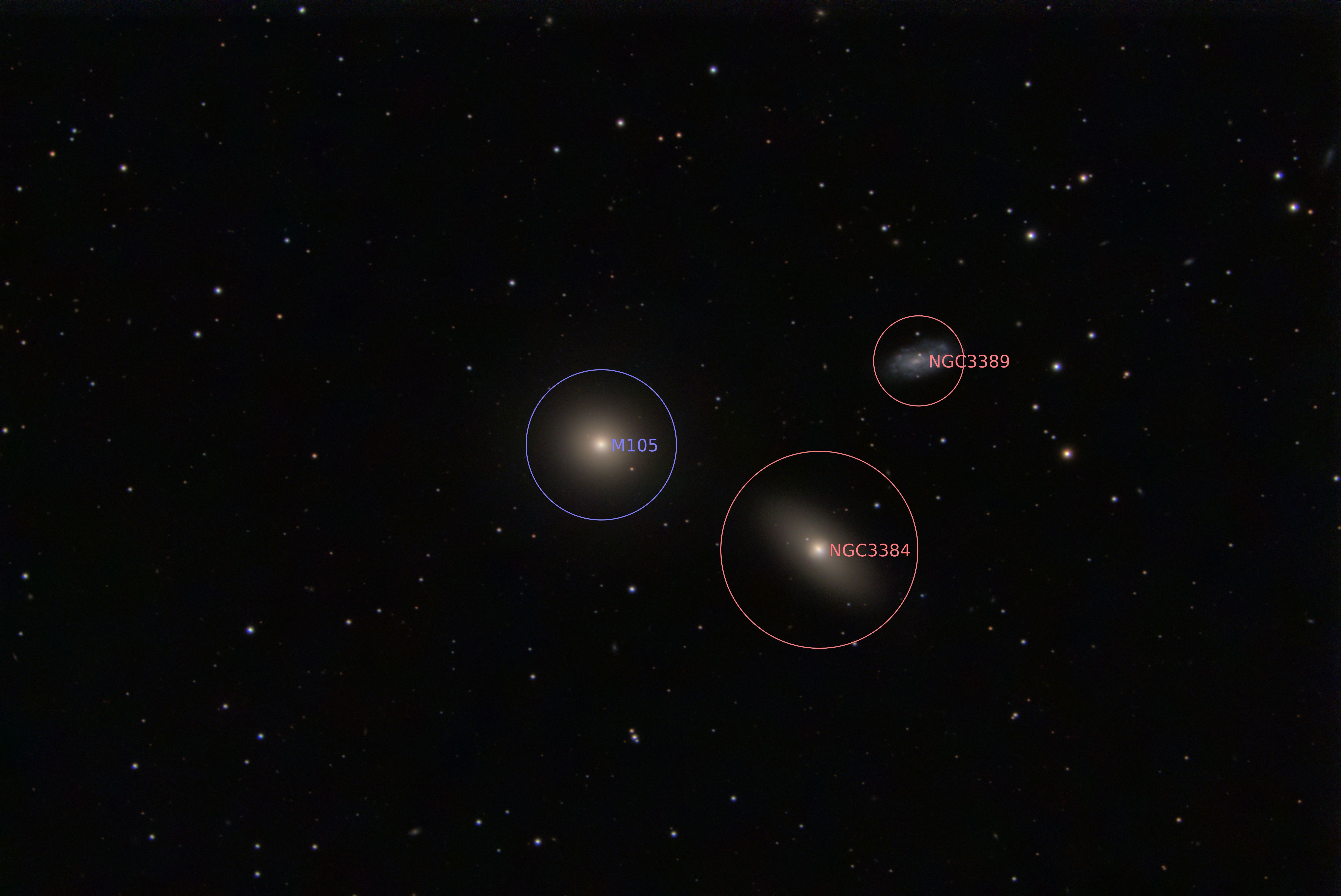
M105 Elliptical Galaxy

Imaging Details
Click to Return to Home Page