Occultation of Moon and Mars 2025
Occultation Background: An occultation is an event that occurs when one object is hidden from the observer by another object that passes between them.
The term occultation is most frequently used to describe lunar occultations, those relatively frequent occasions when the Moon passes in front of a star during the course of its orbital motion around the Earth.
Since the Moon, with an angular speed with respect to the stars of 0.55 arc-seconds/s, has a very thin atmosphere and stars have an angular diameter of at most 0.057 arc-seconds,
a star that is occulted by the Moon will disappear or reappear in 0.1 seconds or less on the Moon's edge, or limb.
Events that take place on the Moon's dark limb are of particular interest to observers, because the lack of glare allows easier observation and timing.
The Moon's orbit is inclined slightly with respect to the ecliptic meaning any star with an ecliptic latitude between –6.6 and +6.6 degrees may be occulted by it.
Three first magnitude stars appear well within that band – Regulus, Spica, and Antares – meaning they may be occulted by the Moon or by planets. Occultations of Aldebaran are in this epoch only possible by the Moon, because the planets pass Aldebaran to the north.
Neither planetary nor lunar occultations of Pollux are currently possible, however several thousand years ago lunar occultations were possible. Some notably close deep-sky objects, such as the Pleiades, can be occulted by the Moon.
Several times during the year the Moon can be seen occulting a planet. Since planets, unlike stars, have significant angular sizes, lunar occultations of planets will create a narrow zone on Earth from which a partial occultation of the planet will occur.
An observer located within that narrow zone could observe the planet's disk partly blocked by the slowly moving Moon.
The same mechanism can be seen with the Sun, where observers on Earth will view it as a solar eclipse. Therefore, a total solar eclipse is essentially the Moon occulting the Sun.
Stars may also be occulted by planets. Occultations of bright stars are rare. In 1959, Venus occulted Regulus, and the next occultation of a bright star (also Regulus by Venus) will be in 2044.
Uranus's rings were first discovered when that planet occulted a star in 1977. On 3 July 1989, Saturn passed in front of the 5th magnitude star 28 Sagittarii.
In rare cases, one planet can pass in front of another. If the nearer planet appears larger than the more distant one, the event is called a mutual planetary occultation.
The last occultation or transit occurred on 3 January 1818 and the next will occur on 22 November 2065, in both cases involving the same two planets—Venus and Jupiter.
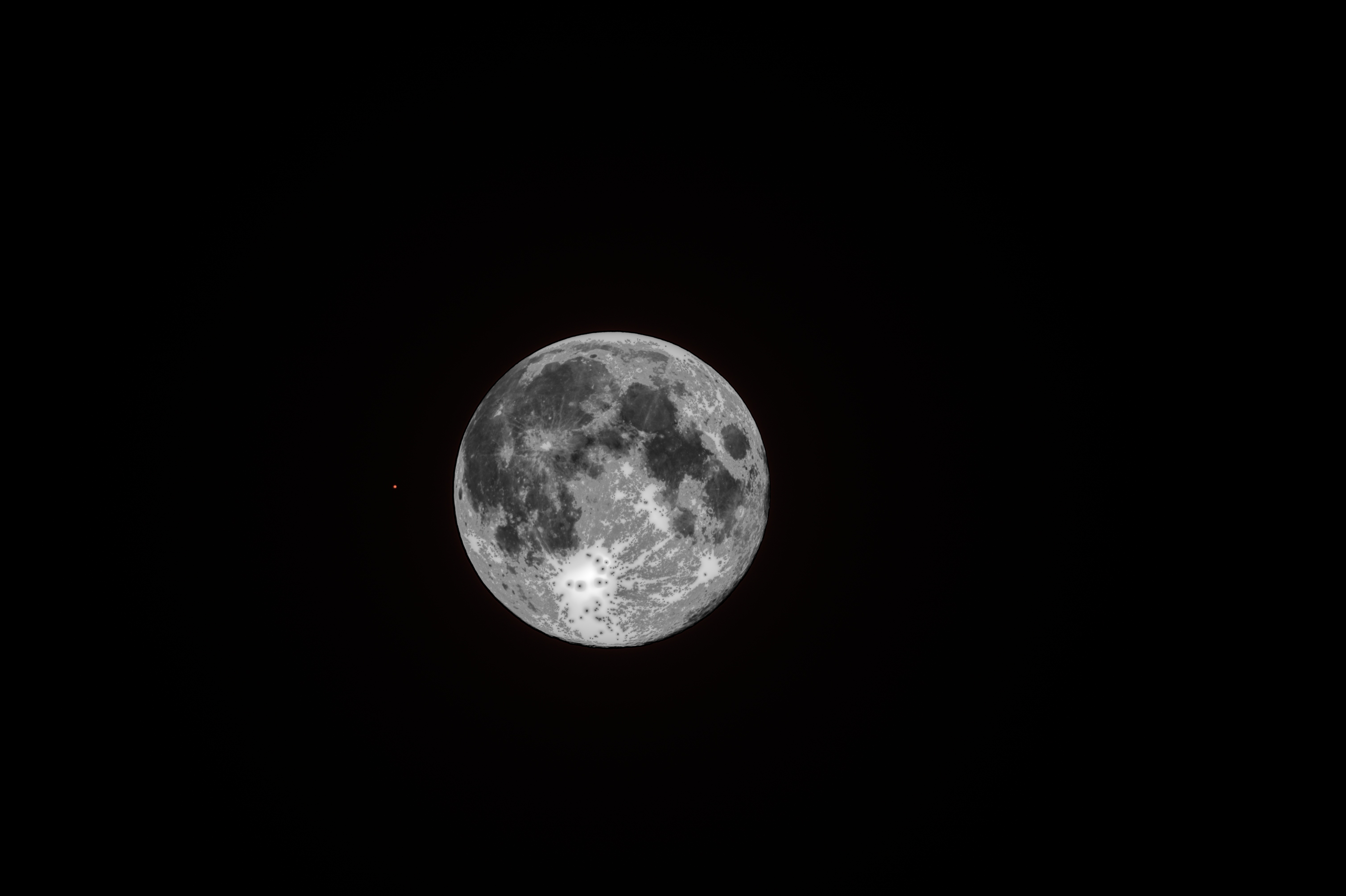
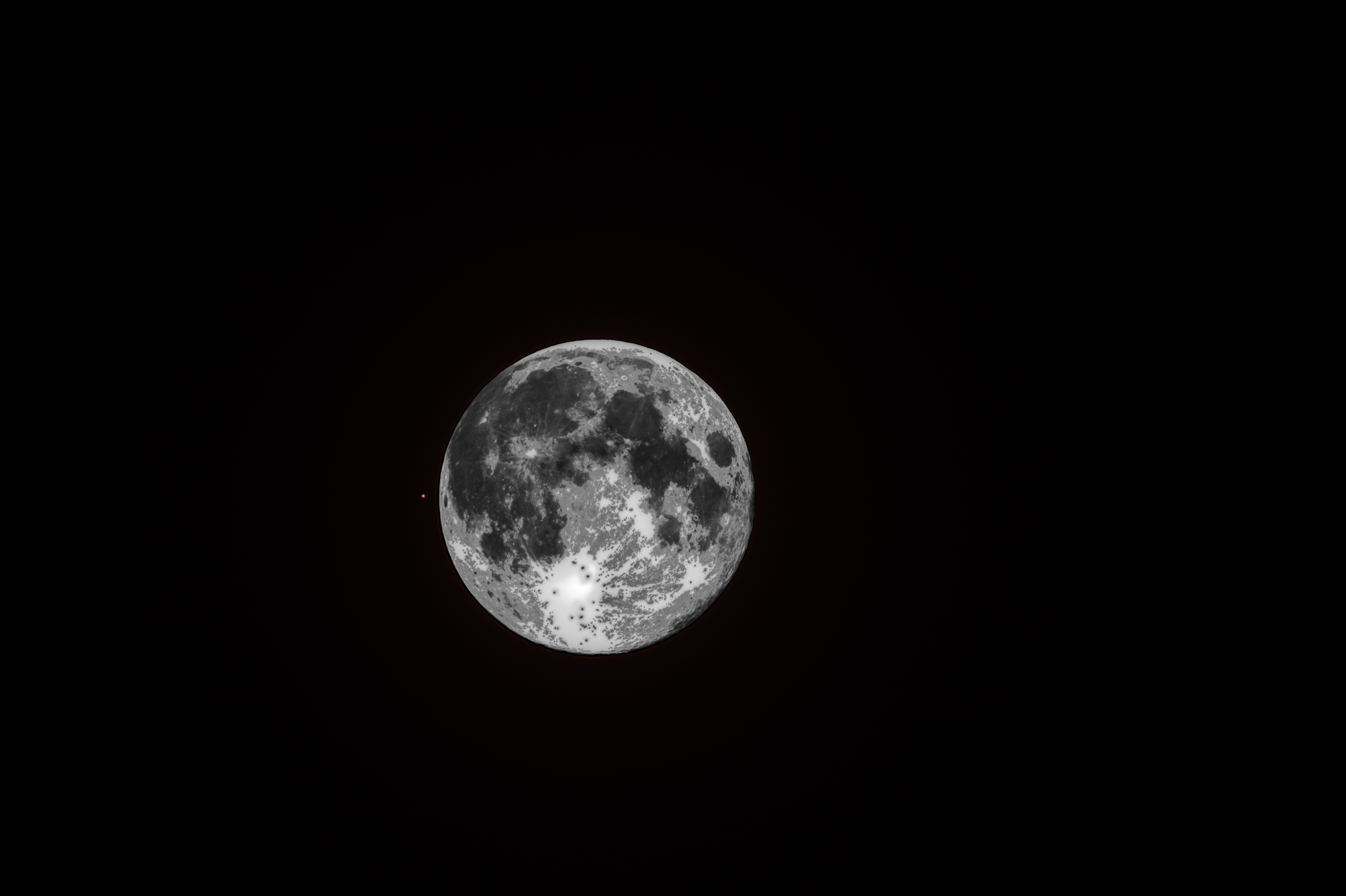
Description: A lunar occultation occurs when the moon completely covers another celestial object. In this case of the January full moon, and the planet Mars.
The moon passed in front of Mars and covered it completely for a period of time.
The red planet was at its closest to Earth for this two-year period on January 12, 2025.
Mars reached opposition, bringing it opposite the sun in our sky, on January 15-16. And on January 13, it appeared very close to the full Wolf Moon.
So close, in fact, that lucky observers in parts of North America, northwest Africa, the Azores and the Cape Verde Islands saw the moon pass in front of – or occult – Mars.
Occultation of the Moon and Mars occurs about once every 14 years or so.
Occultation started at 9:25PM and concluded at 10:42PM.
Occultation of Moon and Mars 2025
Imaging Details
Click to Return to Home Page