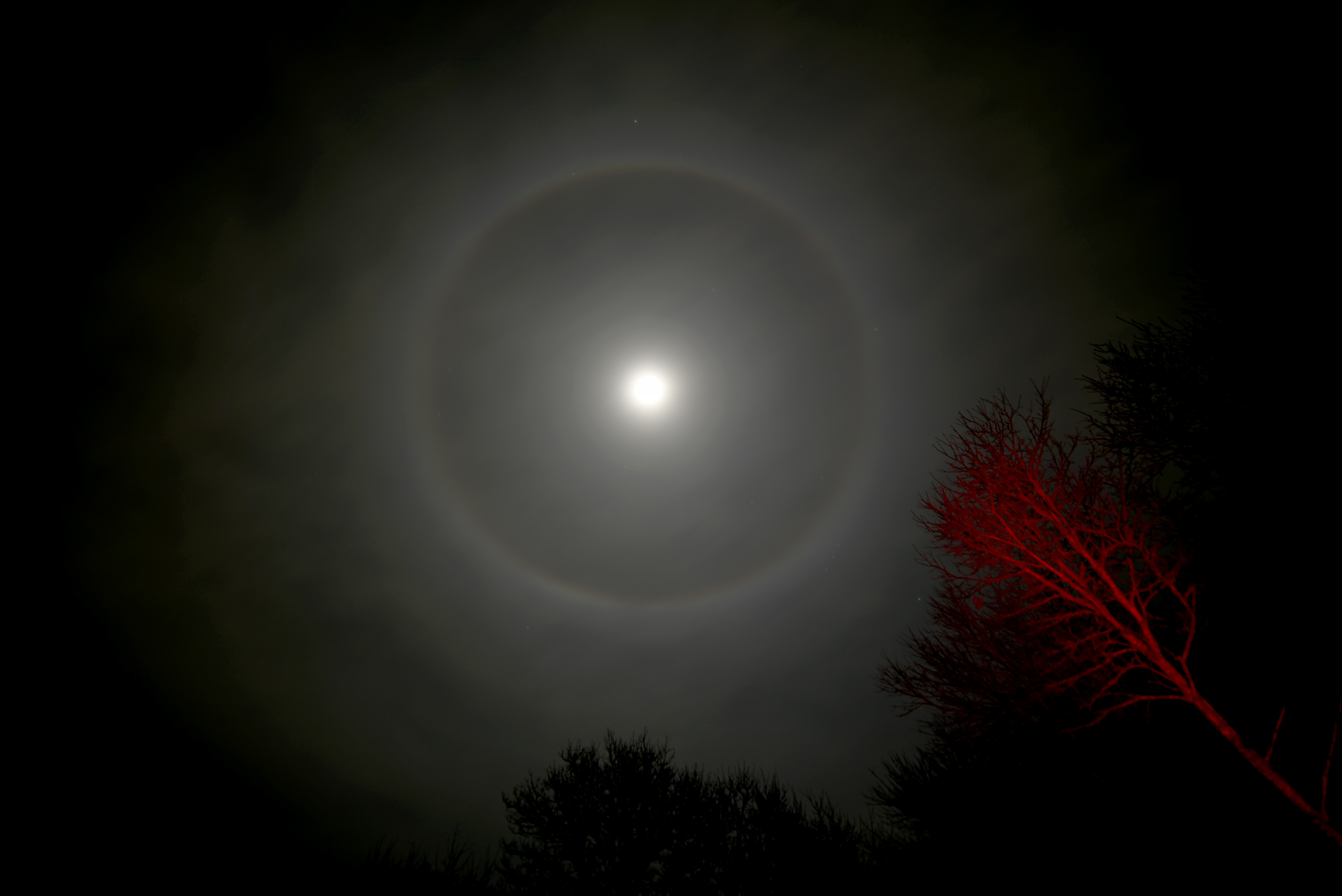
Moondog February 2020
Moondog Background: A moon dog (or moondog) or mock moon, also called a paraselene (plural paraselenae) in meteorology,
is an atmospheric optical phenomenon that consists of a bright spot to one or both sides of the Moon.
They are exactly analogous to sun dogs.
A member of the halo family, moon dogs are caused by the refraction of moonlight by hexagonal-plate-shaped ice crystals in cirrus or cirrostratus clouds.
They typically appear as a pair of faint patches of light, at around 22° to the left and right of the Moon, and at the same altitude above the horizon as the Moon. They may also appear alongside 22° halos.
Moon dogs are rarer than sun dogs because the Moon must be bright, about quarter moon or more, for the moon dogs to be observed.
Moon dogs show little color to the unaided human eye because their light is not bright enough to activate the eye's cone cells.
Description: Moondogs are seen most often in the winter when ice crystals may be present in the atmosphere.
But they can appear anytime of the year when hexagon-shaped ice crystals might be high in the sky, or also when thin cirrus or cirrostratus clouds are just right.
What happens is that the ice crystals or clouds refract the moonlight, creating blobs or arcs of light to the left and right of the Moon, or sometimes just on one side.
Also, the Moon usually needs to be full or nearly full, along with being low in the sky for the effect to be produced.
The angular separation of the light blobs from the Moon is usually 22 degrees.
Sometimes, a full halo of light around the Moon will also appear in conjunction with the Moondogs; other times smaller arcs of light will be part of the effect, but often Moondogs appear without any other effects.
Moondog 2020

Click to Return to Home Page