IC 2233 and NGC 2537
Common Name: Bear Paw Galaxy (NGC 2537)
Also Known as: UGC 4278, LEDA 23071 (IC2233) Bear Paw Galaxy, Bear Claw Galaxy, Arp 6, PGC 23040, UGC 4274 (NGC 2537)
Object Type: Galaxies
Constellation: : Lynx
Distance from Earth: 40 million light years (both)
Apparent Magnitude: 12.63 (IC 2233), 12.3 (NGC 2537)
Coordinates: RA 8H 15M 49S DEC 45 deg 39 min 41 sec (IC 2233) RA 8H 13M 14.6S DEC 45 deg 59 min 23 sec (NGC 2537)
Actual Size: 13,000 light years (NGC 2537)
Apparent Dimensions: 4.9 arcminutes x 0.5 arcminutes (IC 2233), 1.7 arcminutes x 1.5 arcminutes (NGC 2537)
Discovered by: While looking through his 18.7 inch reflecting telescope William Herschel found on 6 February 1788 NGC 2537 that he described as follows:
«Pretty bright, round, almost of an even light throughout, approaching to planetary, but ill defined and a little fainter on the edges 3/4 or 1' diameter.»
He cataloged it as IV 55 (class IV: planetary nebulae: stars with burs, with milky chevelure, with short rays, remarkable shapes, etc.)
In 1833 John Herschel listed this object as h 491 and described it as follows: «Pretty faint; round; 60"; very nearly uniformly bright, but hazy at edges.
It is a resolved globular cluster. Being a remarkably fine night, I see the stars; they are 20 m; a star 9.10 mag is 40° south following at distance 2'.»
In his «General Catalogue» appeared in 1864 he listed the object a globular cluster with the designation GC 1629.
Dreyer took over this mis-classification in his «New General Catalogue» of 1888 where he listed the object as NGC 2537.
In 1966 Halton Arp published his «Atlas of Peculiar Galaxies», where he ordered galaxies into groups based on purely morphological criteria. The galaxy NGC 2537 is listed as Arp 6 in the first group «spiral galaxies, low surface brightness»
The edge-on galaxy IC 2233 was discovered on 25 March 1894 by the British Astronomer Isaac Robers. He found it by photography, using the 20 inch reflector at his observatory «Starfield», Crowborough Hill, Sussex.
Description: IC 2233 is a spiral galaxy lying in the constellation of Lynx. IC 2233 is located between 26 and 40 million light-years away from Earth.
A comparatively quiet galaxy with a low rate of star formation (less than one solar mass every twenty years), it was long thought to be possibly interacting with the Bear's Paw galaxy.
However, this is now considered highly unlikely as radio observations with the Very Large Array showed the two galaxies lie at different distances.
NGC 2537 is a compact blue dwarf galaxy. The small spiral galaxy NGC 2537A (MCG+08-15-051) four arcminutes to the east shows a redshift of z=0.04001 and therefore is much further away and not associated with its optical neighbour.
NGC 2537 is a blue compact dwarf galaxy in the constellation Lynx, located around 3 degrees NNW of 31 Lyncis.
NGC 2537 belongs to the iE class of Blue Compact Dwarf (BCD) classification, which is described as galactic spectra with an underlying smooth elliptical Low Surface Brightness component with a superimposed "knotted" star formation component.
NGC 2537 was long thought to be possibly interacting with IC 2233. However, even though they may lie at the same distance, neither display the hallmarks of a mutual interaction.
Click Below Image(s) for Full Size:
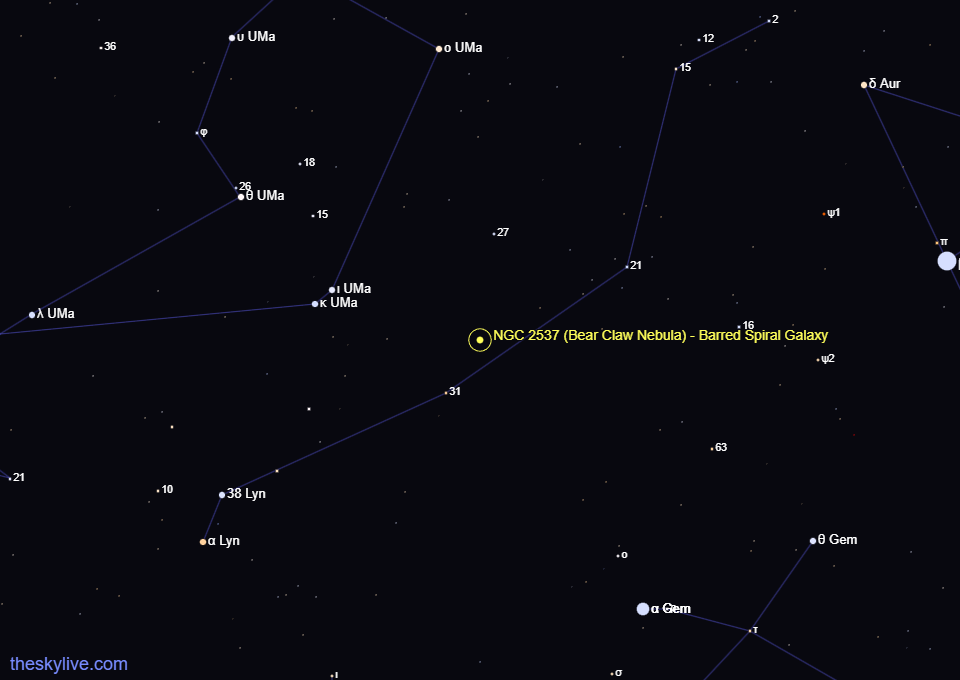
These galaxies are best seen in the winter months.
Platesolve
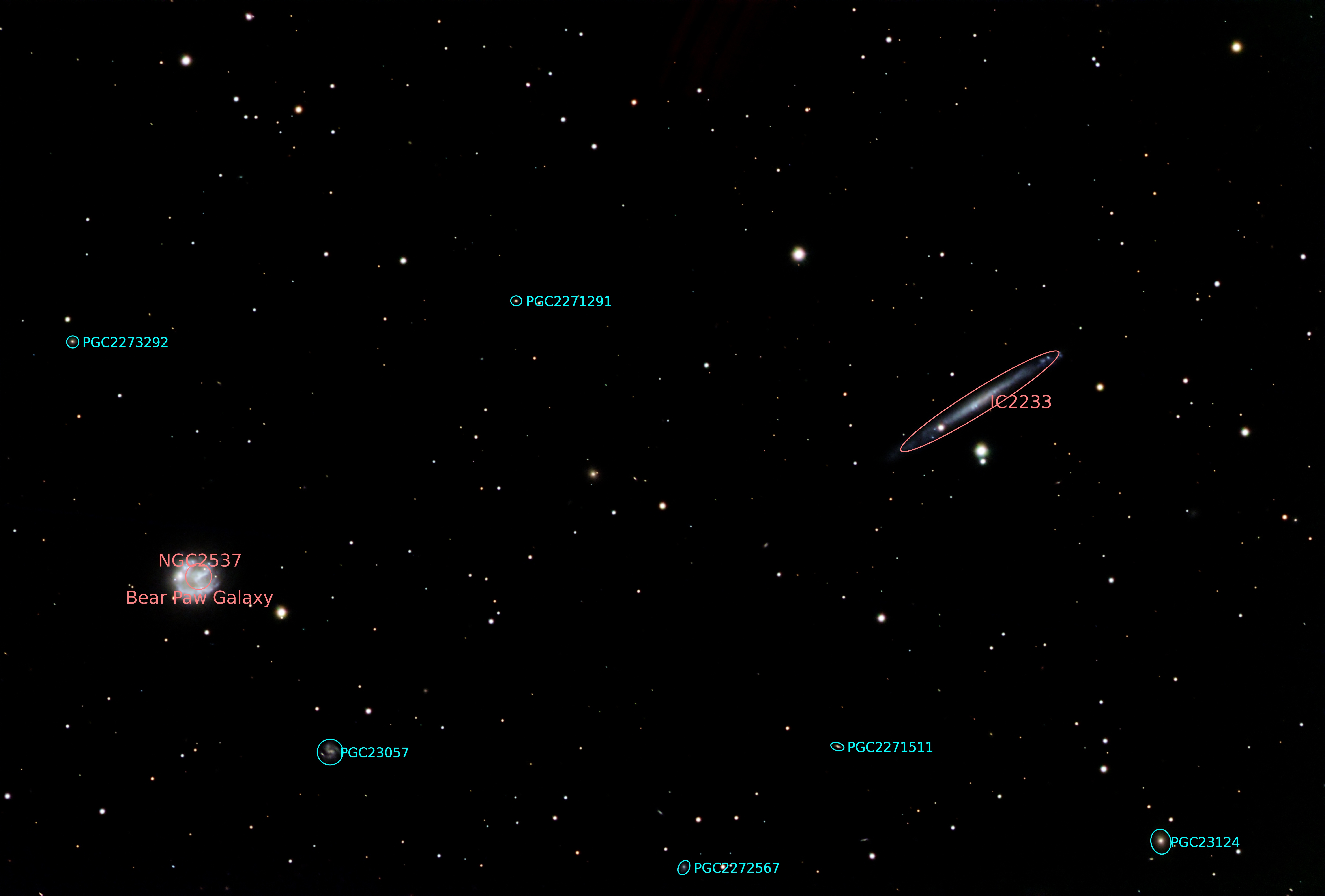
IC 2233 and NGC 2537 Galaxies

Imaging Details
Click to Return to Home Page