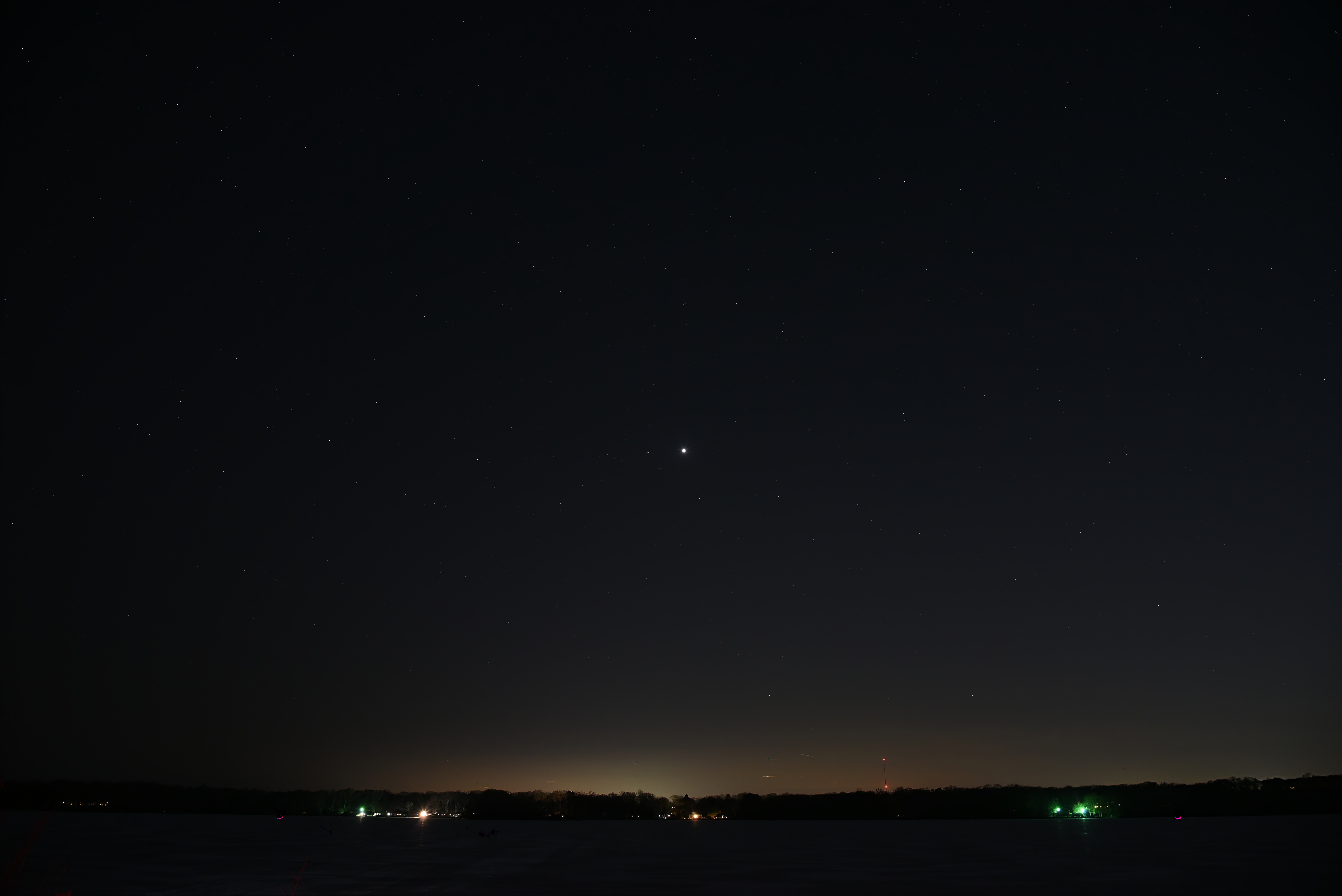
Conjunction of Venus and Saturn January 2025
Conjunction Background: Occasionally, two or more objects meet up with each other in our sky.
Astronomers use the word conjunction to describe these meetings. The word conjunction comes from Latin, meaning to join together.
In astronomy, a conjunction occurs when two astronomical objects or spacecraft appear to be close to each other in the sky.
This means they have either the same right ascension or the same ecliptic longitude, usually as observed from Earth.
When two objects always appear close to the ecliptic—such as two planets, the Moon and a planet, or the Sun and a planet—this fact implies an apparent close approach between the objects as seen in the sky.
A related word, appulse, is the minimum apparent separation in the sky of two astronomical objects.
Conjunctions involve either two objects in the Solar System or one object in the Solar System and a more distant object, such as a star. A conjunction is an apparent phenomenon caused by the observer's perspective: the two objects involved are not actually close to one another in space.
Conjunctions between two bright objects close to the ecliptic, such as two bright planets, can be seen with the naked eye.
Description: Venus is bright and visible to the naked eye, shining at mag. –4.3. It was above the southwest horizon in the early evening, when it looks like a bright 'star' in the twilight sky.
Saturn is dimmer at mag. +0.8 and located in the same part of the sky as Venus, just to the left of the planet. It won't be as bright as Venus
The best time to look at the conjunction was around 45 minutes after sunset.
Venus and Saturn will set less than four hours after sunset, cutting the observing window short.
Although the two planets will both be easy to see, there will be a massive contrast in their brightness, with Venus shining 110 times brighter than Saturn.
The conjunction is an illusion. On Saturday, Venus and Saturn will be separated by 875 million miles — about eight times the distance between Venus and Earth.
Although no equipment is required to see the conjunction, a pair of binoculars or a small telescope will reveal Venus to be a crescent.
Venus is currently shrinking to a crescent as it gets closer to Earth.
Venus is currently in its “evening star” apparition, approaching Earth during its shorter 225-day orbit of the sun.
Its speed and proximity to Earth are causing it to brighten and grow in apparent size as it moves closer while simultaneously becoming a crescent.
It will get closest to Earth on Feb. 19, reaching a brilliant magnitude of -4.9 despite being just 13%-lit.
As it passes Earth, Venus will rapidly sink out of the post-sunset sky and cross into the sun’s glare on March 22. It will then emerge as a bright “morning star” before sunrise.
Conjunction of Venus and Saturn

Imaging Details
Click to Return to Home Page