Conjunction of Venus, Jupiter and Regulus June 2015
Conjunction Background: Occasionally, two or more objects meet up with each other in our sky.
Astronomers use the word conjunction to describe these meetings. The word conjunction comes from Latin, meaning to join together.
In astronomy, a conjunction occurs when two astronomical objects or spacecraft appear to be close to each other in the sky.
This means they have either the same right ascension or the same ecliptic longitude, usually as observed from Earth.
When two objects always appear close to the ecliptic—such as two planets, the Moon and a planet, or the Sun and a planet—this fact implies an apparent close approach between the objects as seen in the sky.
A related word, appulse, is the minimum apparent separation in the sky of two astronomical objects.
Conjunctions involve either two objects in the Solar System or one object in the Solar System and a more distant object, such as a star. A conjunction is an apparent phenomenon caused by the observer's perspective: the two objects involved are not actually close to one another in space.
Conjunctions between two bright objects close to the ecliptic, such as two bright planets, can be seen with the naked eye.
You can keep up to date with upcoming conjunctions by visiting 'Earthsky.org'
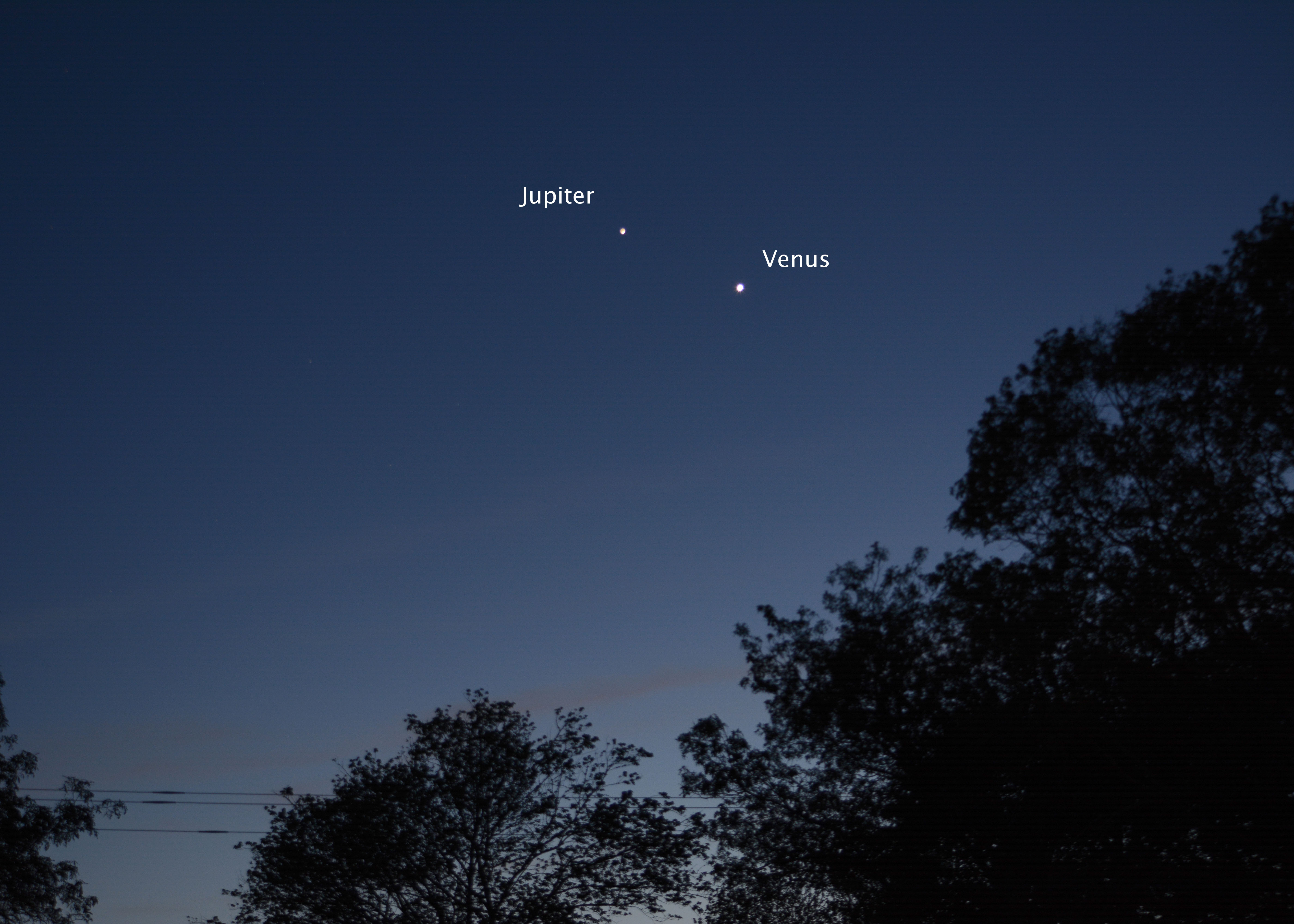
Description: The bright planets Venus and Jupiter have been moving closer together for weeks, and on June 30, 2015, they make their closest approach when they pass less than a full-Moon-width from each other in the western sky after sunset.
This beautiful conjunction of two bright planets is an ideal time for a photo-op and an great opportunity to see the clockwork motion of the solar system in action.
Venus, Jupiter, and the crescent Moon in the western sky after sunset on June 19, 2015. The two bright planets were within 0.3 degrees of each other on June 30, 2015
The two planets will fit together in the same low-power field of view in a telescope, and remarkably, they will appear the same size. Venus is a tiny crescent, bright and featureless, while Jupiter displays cloud bands and its four biggest moons. While each spans about 32 arc-seconds in apparent size, in real terms Jupiter is 12x larger and 12x farther away.
Conjunction of Venus, Jupiter and Regulus

Imaging Details
Click to Return to Home Page