Conjunction of Moon & Jupiter Jan 2026
Conjunction Background: Occasionally, two or more objects meet up with each other in our sky.
Astronomers use the word conjunction to describe these meetings. The word conjunction comes from Latin, meaning to join together.
In astronomy, a conjunction occurs when two astronomical objects or spacecraft appear to be close to each other in the sky.
This means they have either the same right ascension or the same ecliptic longitude, usually as observed from Earth.
When two objects always appear close to the ecliptic—such as two planets, the Moon and a planet, or the Sun and a planet—this fact implies an apparent close approach between the objects as seen in the sky.
A related word, appulse, is the minimum apparent separation in the sky of two astronomical objects.
Conjunctions involve either two objects in the Solar System or one object in the Solar System and a more distant object, such as a star. A conjunction is an apparent phenomenon caused by the observer's perspective: the two objects involved are not actually close to one another in space.
Conjunctions between two bright objects close to the ecliptic, such as two bright planets, can be seen with the naked eye.
You can keep up to date with upcoming conjunctions by visiting 'Earthsky.org'
Description: Jupiter appears as a steady "evening star" less than 5 degrees — roughly the width of your three middle fingers held to arm's length —
to the lower right of the lunar disk in the eastern sky, with the bright stars Castor and Pollux twinkling close to its left.
The 97%-lit moon appears full to the casual observer, just two days out from its full moon phase on Feb. 1. Jupiter, meanwhile, will look particularly bright and prominent in late January,
just a few weeks after reaching opposition on Jan. 10, when it lay opposite the sun in Earth's sky and shone at its best for the year.
The moon and Jupiter are close enough to fit comfortably in the field of view of a pair of 10X50 binoculars
Click Below Image(s) for Full Size:
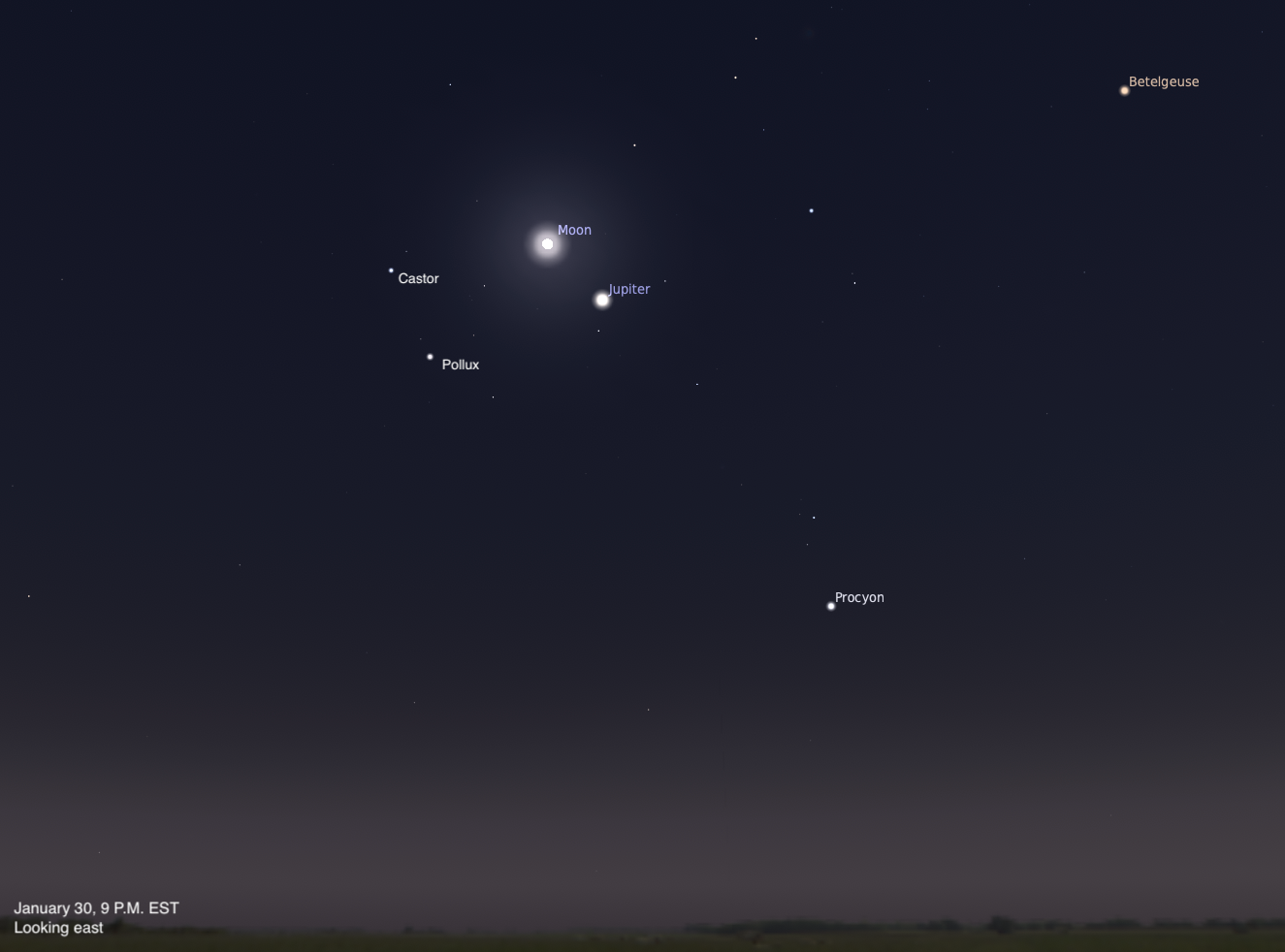
Conjunction of Moon & Jupiter
Jupiter to the right and below the Moon

Imaging Details
Click to Return to Home Page