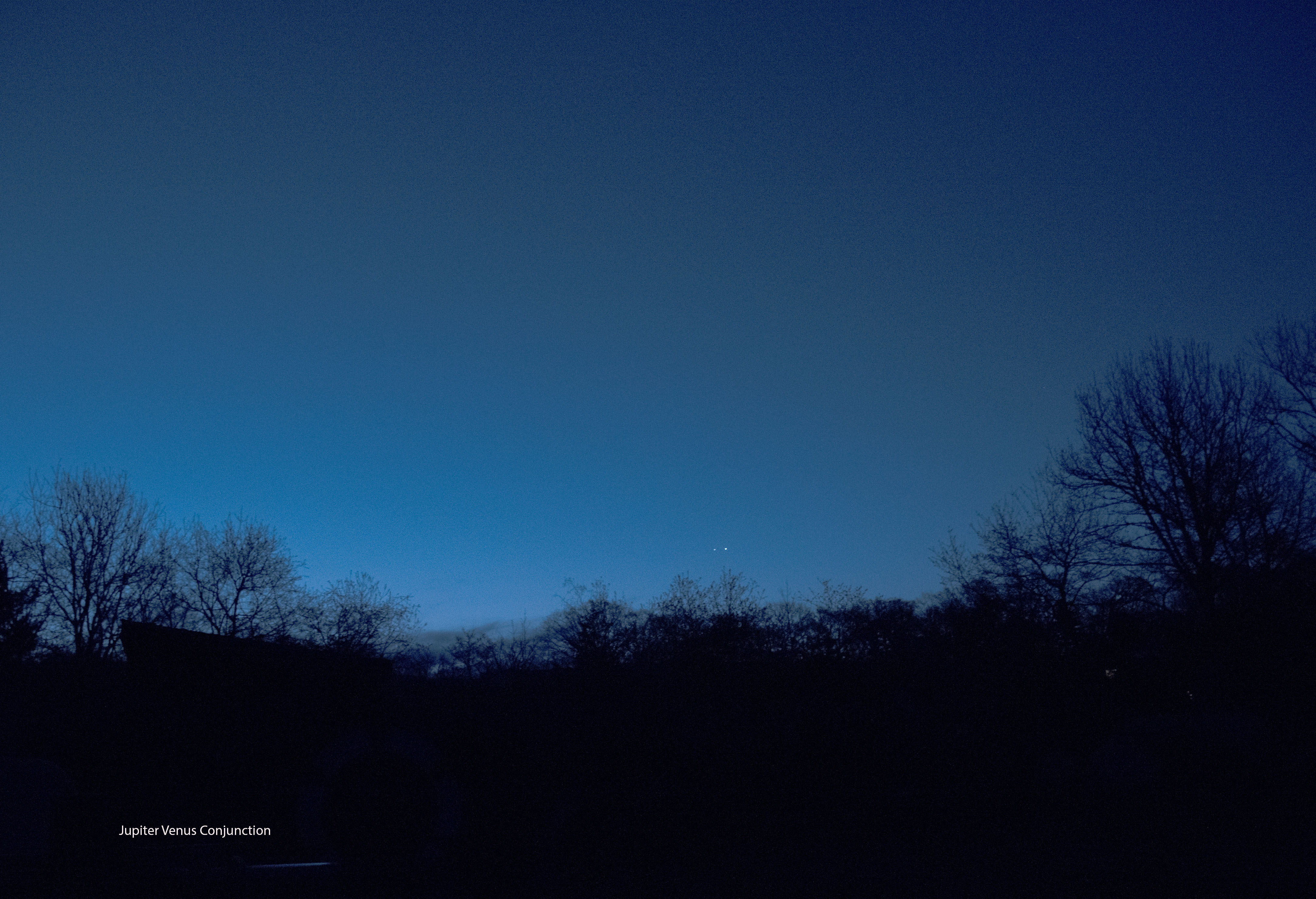
Conjunction of Jupiter & Venus April 2022
Conjunction Background: Occasionally, two or more objects meet up with each other in our sky.
Astronomers use the word conjunction to describe these meetings. The word conjunction comes from Latin, meaning to join together.
In astronomy, a conjunction occurs when two astronomical objects or spacecraft appear to be close to each other in the sky.
This means they have either the same right ascension or the same ecliptic longitude, usually as observed from Earth.
When two objects always appear close to the ecliptic—such as two planets, the Moon and a planet, or the Sun and a planet—this fact implies an apparent close approach between the objects as seen in the sky.
A related word, appulse, is the minimum apparent separation in the sky of two astronomical objects.
Conjunctions involve either two objects in the Solar System or one object in the Solar System and a more distant object, such as a star. A conjunction is an apparent phenomenon caused by the observer's perspective: the two objects involved are not actually close to one another in space.
Conjunctions between two bright objects close to the ecliptic, such as two bright planets, can be seen with the naked eye.
You can keep up to date with upcoming conjunctions by visiting 'Earthsky.org'
Description: On April 30, Venus was be 0.2 degrees south of Jupiter.
For observers in the Americas, they were separated by the same angular distance as a full moon, about 1/2 degree.
It's the closest they've appeared since 2016 and won't happen again until March 2023.
Venus is substantially brighter at magnitude -4.1, while Jupiter shines at magnitude -2.1, which is about one sixth as bright as Venus.
Binoculars help separate these two worlds in their bright planetary glare. Even though Venus and Jupiter appear next to each other in the sky, they are really nowhere near each other in space.
They are separated by 430 million miles (690 million km), or nearly five times the Earth–sun distance!
Conjunction of Jupiter & Venus

Imaging Details
Click to Return to Home Page