Caldwell 43
Common Name: The Little Sombrero
Also Known as: NGC 7814
Object Type: Spiral Galaxy
Constellation: Pegasus
Distance from Earth: 40 million light years
Apparent Magnitude: 11.6
Coordinates: RA 00H 03M 14.9S DEC 16 deg 08 min 44 sec
Actual Size: 60,000 light years in diameter
Apparent Dimensions: 5.5 arc-minutes x 2.3 arc-minutes
Discovered by: NGC 7814 was discovered by William Herschel in 1784.
Description: NGC 7814 is a spiral galaxy about 40 million light-years away in the constellation Pegasus. The galaxy is seen edge-on from Earth.
It is a miniature version of the Sombrero Galaxy (Messier 104). This is NGC 7814, also known as the “Little Sombrero”. Its larger namesake the Sombrero Galaxy is another stunning example of an edge-on galaxy — in fact,
the “Little Sombrero” is about the same size as its bright namesake at about 60,000 light-years across, but as it lies further away, it appears smaller in the sky.
NGC 7814 has a bright central bulge and a bright halo of glowing gas extending outwards into space.
The dusty spiral arms appear as dark streaks. they consist of dusty material that absorbs and blocks light from the galactic center behind it.
The star field behind NGC 7814 is known for its density of faint, remote galaxies.
It's among the few bright galaxies that exhibit modest distortion and twisting of the galaxy's plane in optical wavelengths.
The light from the distant background galaxies becomes more red as it passes through NGC 7814's halo. This has been used to determine the amount of gas and dust in the halo.
Both Sombrero and Little Sombrero are spiral galaxies seen edge-on, and both have extensive halos and central bulges cut by a thin disk with thinner dust lanes in silhouette.
NGC 7814 has an estimated size of 60,000 light-years across. That actually makes the Little Sombrero about the same physical size as its better known namesake, appearing smaller and fainter only because it is farther away.
Click Below Image(s) for Full Size:
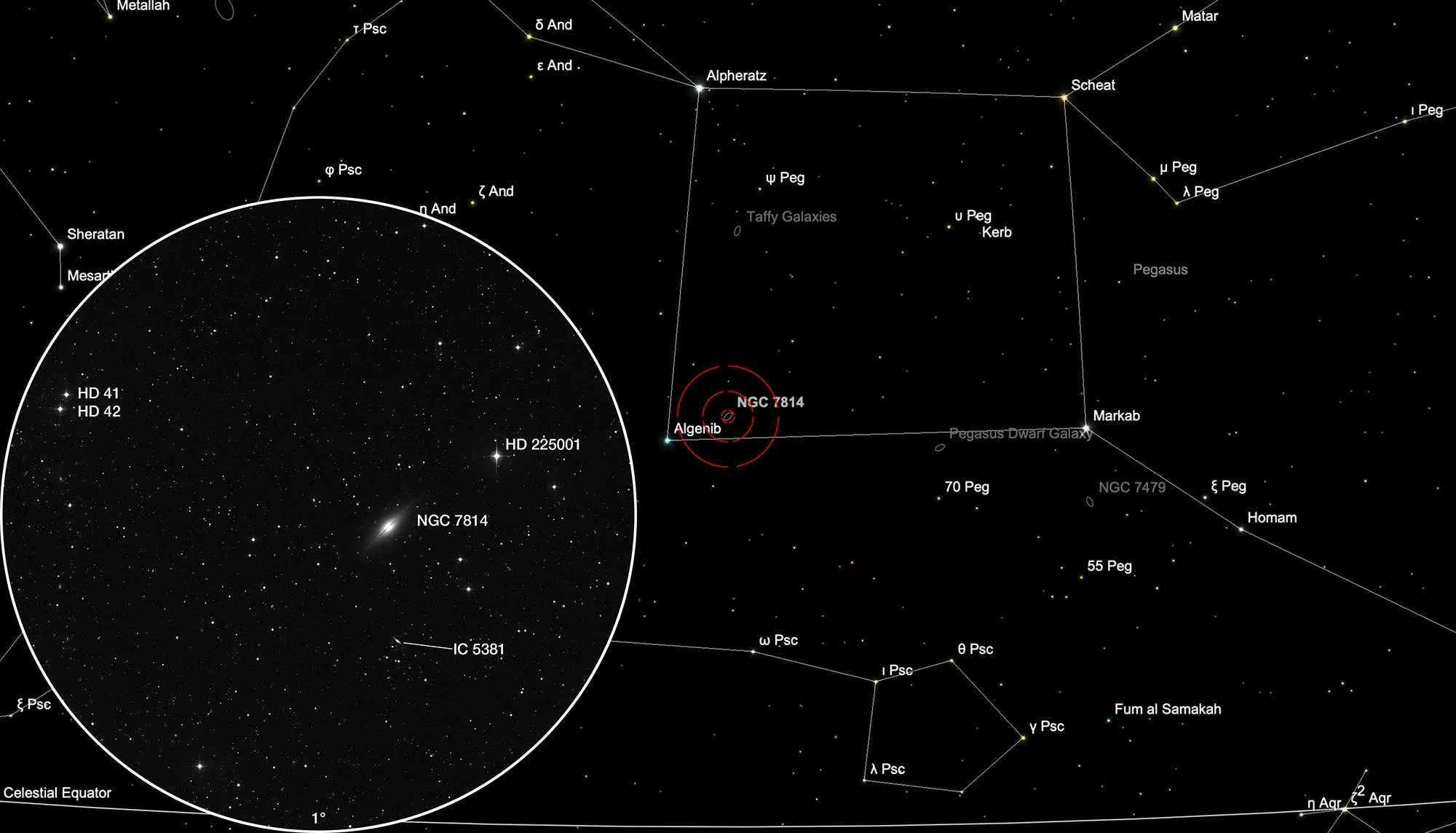
NGC 7814 is situated close to the celestial equator and, as such, it is at least partly visible from both hemispheres in certain times of the year.
It is best observation time is July to January.
Throughout the autumn both are well placed and easy to find.
Platesolve
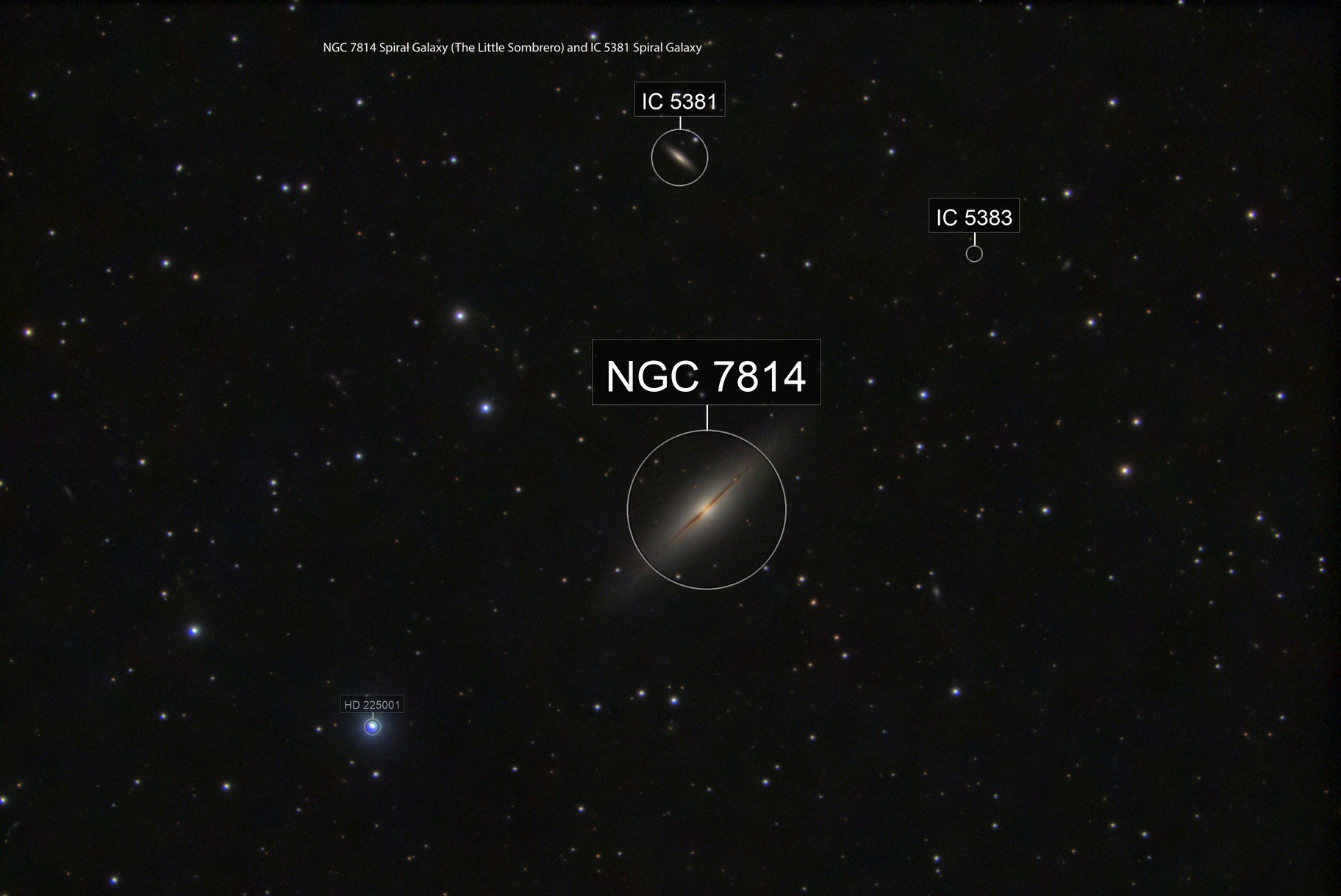
NGC 7814 Galaxy
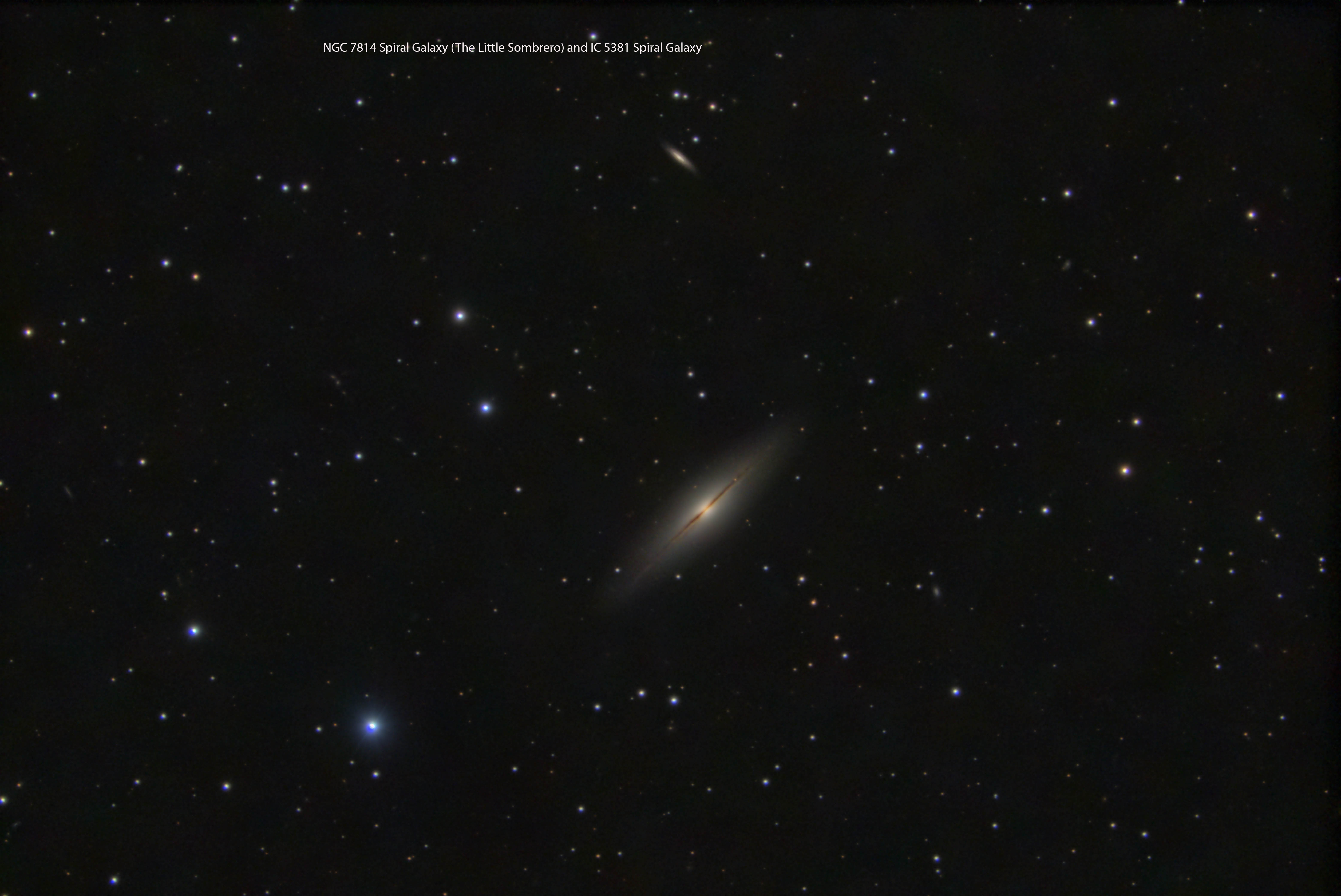

Imaging Details
Click to Return to Home Page