Caldwell 39
Common Name: Eskimo Nebula
Also Known as: NGC 2392, Clown-faced Nebula, Lion Nebula
Object Type: Bipolar Double-shell Planetary Nebula
Constellation: Gemini
Distance from Earth: 6,520 light years
Apparent Magnitude: 10.1
Coordinates: RA 07H 29M 10.7669S DEC 20 deg 54 min 42.488 sec
Actual Size: 0.68 light years in diameter
Apparent Dimensions: 48 arc-minutes x 48 arc-minutes
Discovered by: The nebula was discovered by William Herschel on January 17, 1787, in Slough, England.
He described it as "A star 9th magnitude with a pretty bright middle, nebulosity equally dispersed all around. A very remarkable phenomenon".
Description: NGC 2392 is a is a bipolar double-shell planetary nebula, a phase that results when a star like the sun becomes a red giant and sheds its outer layers.
Stars like the Sun can become remarkably photogenic at the end of their life. A good example is NGC 2392, which is located about 4,200 light years from Earth.
NGC 2392, is what astronomers call a planetary nebula. This designation, however, is deceiving because planetary nebulas actually have nothing to do with planets.
The term is simply a historic relic since these objects looked like planetary disks to astronomers in earlier times looking through small optical telescopes.
Instead, planetary nebulas form when a star uses up all of the hydrogen in its core -- an event our Sun will go through in about five billion years.
When this happens, the star begins to cool and expand, increasing its radius by tens to hundreds of times its original size.
Eventually, the outer layers of the star are carried away by a 50,000 kilometer per hour wind, leaving behind a hot core.
This hot core has a surface temperature of about 50,000 degrees Celsius, and is ejecting its outer layers in a much faster wind traveling six million kilometers per hour.
The radiation from the hot star and the interaction of its fast wind with the slower wind creates the complex and filamentary shell of a planetary nebula.
Eventually the remnant star will collapse to form a white dwarf star.
NGC 2392 resembles a person's head surrounded by a parka hood.
It is surrounded by gas that composed the outer layers of a Sun-like star.
The visible inner filaments are ejected by a strong wind of particles from the central star.
The outer disk contains unusual, light-year-long filaments.
Although this bright central region resembles a ball of twine, it is a bubble of material being blown into space by the central star's intense "wind" of high-speed material.
The planetary nebula began forming about 10,000 years ago, when the dying star began flinging material into space.
The nebula is composed of two elliptically shaped lobes of matter streaming above and below the dying star.
A ring of dense material around the star's equator, ejected during its red giant phase, created the nebula's shape.
This dense waist of material is plodding along at 72,000 miles per hour, preventing high-velocity stellar winds from pushing matter along the equator.
Instead, the 900,000-mile-per-hour winds are sweeping the material above and below the star, creating the elongated bubbles.
Click Below Image(s) for Full Size:
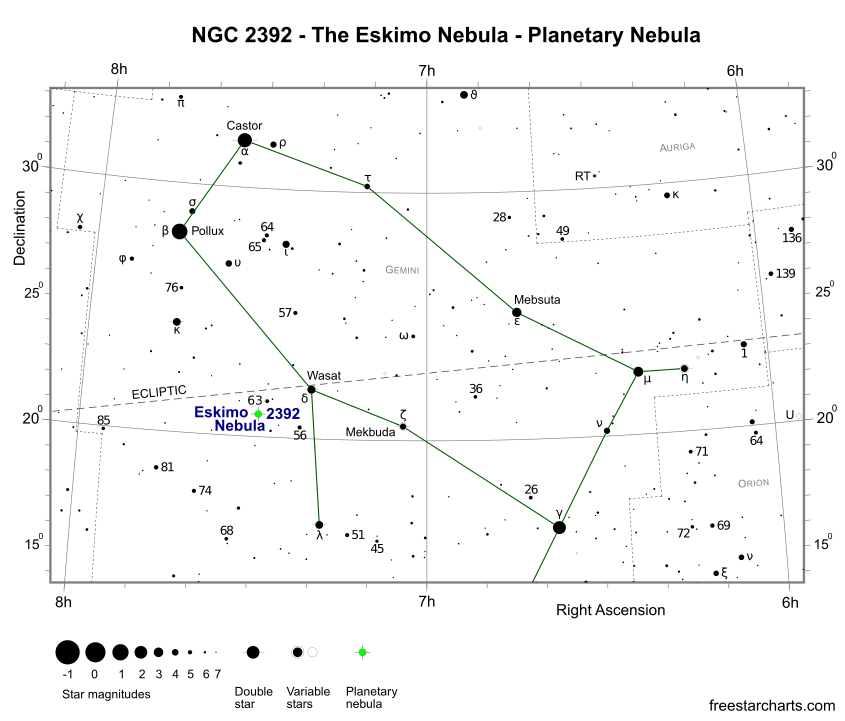
A small telescope shows it as an 8th magnitude star-like object, distinguishable by its soft fuzzy glow and perceptible disc which measures about 40" across.
A ghostly bluish-green color becomes evident with larger telescopes.
The Eskimo Nebula in the constellation of Gemini is relatively easy to find: You start with the 3.5m star Wasat (Delta Gem), which forms an almost equilateral triangle with the two 5mag stars 63 and 58 Gem.
The telescope can be easily aligned with this using the Telrad. Immediately about two arc minutes south of an 8.3mag bright star, a diffuse patch can be seen even at low magnification.
The best time to view NGC 2392 is in the winter months.
NGC 2392 Planetary Nebula

Imaging Details
Click to Return to Home Page