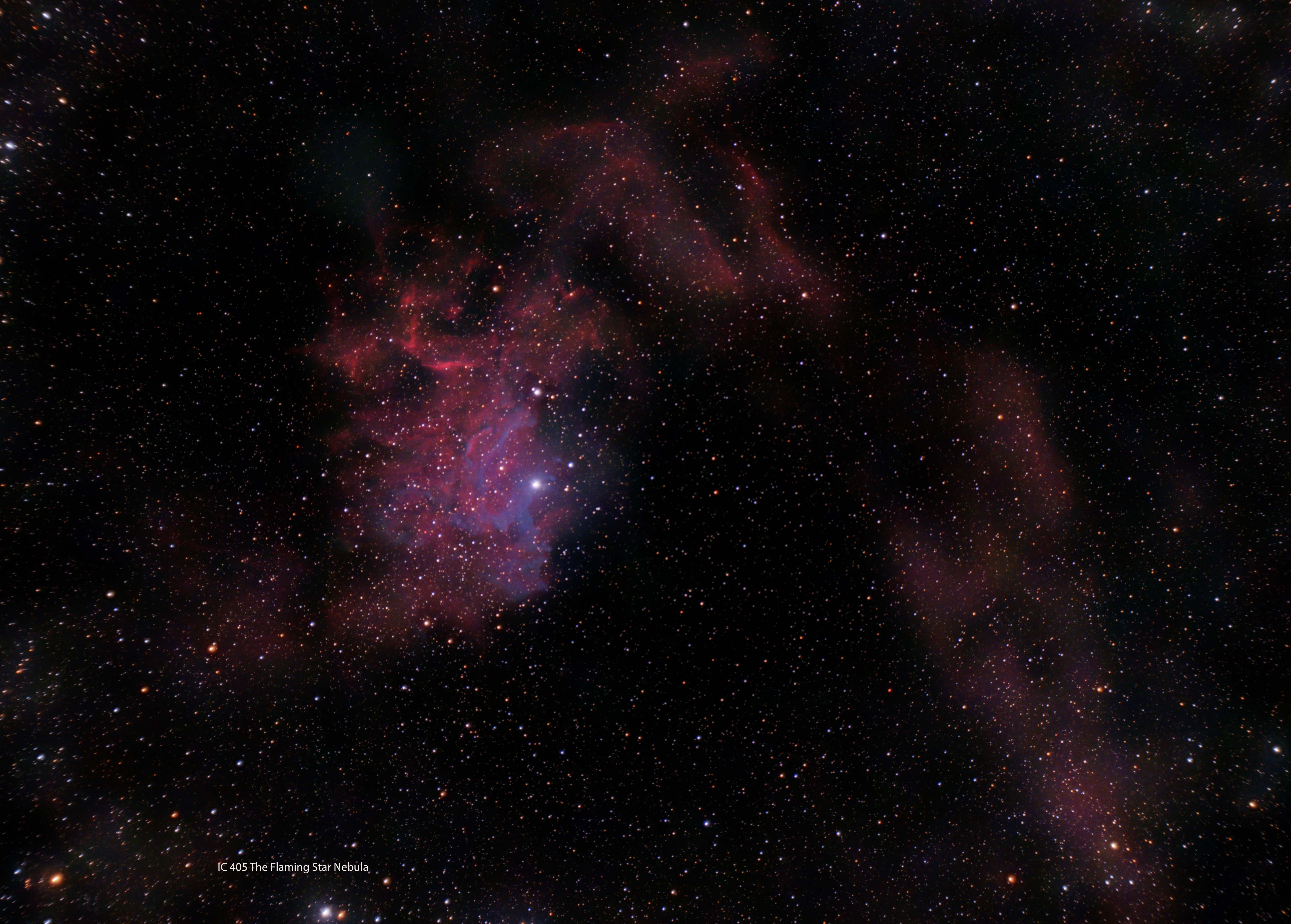
Caldwell 31
Common Name: The Flaming Star Nebula
Also Known as: IC 405
Object Type: Emission and Reflection Nebula
Constellation: Auriga
Distance from Earth: 1,500 light years
Apparent Magnitude: 6.0
Coordinates: RA 05H 16M 05S DEC 34 deg 27 min 49 sec
Actual Size: 5,000 light year in diameter
Apparent Dimensions: 37 arc-minutes x 10 arc-minutes
Discovered by: : IC 405 was discovered by John Martin Schaberle in 1892.
Description: It is located near the emission nebula IC 410, the open clusters M38 and M36, and the K-class star Iota Aurigae.
Rippling dust and gas lanes give the Flaming Star Nebula its name.
The orange and purple colors of the nebula are present in different regions and are created by different processes.
The bright star AE Aurigae is so hot it is blue, emitting light so energetic it knocks electrons away from surrounding gas.
When a proton recaptures an electron, red light is frequently emitted.
The purple region's color is a mix of this red light and blue light emitted by AE Aurigae but reflected to us by surrounding dust.
The two regions are referred to as emission nebula and reflection nebula, respectively.
Click Below Image(s) for Full Size:
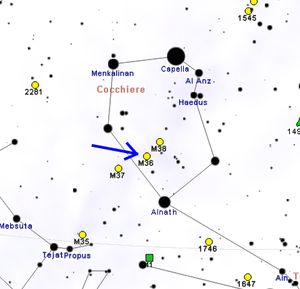
The Flaming Star Nebula is bright enough to be observed and photographed through a small telescope under the right conditions.
From mid-northern latitudes, the best time to observe and photograph the Flaming Star Nebula is in the late fall or early winter.
Platesolve
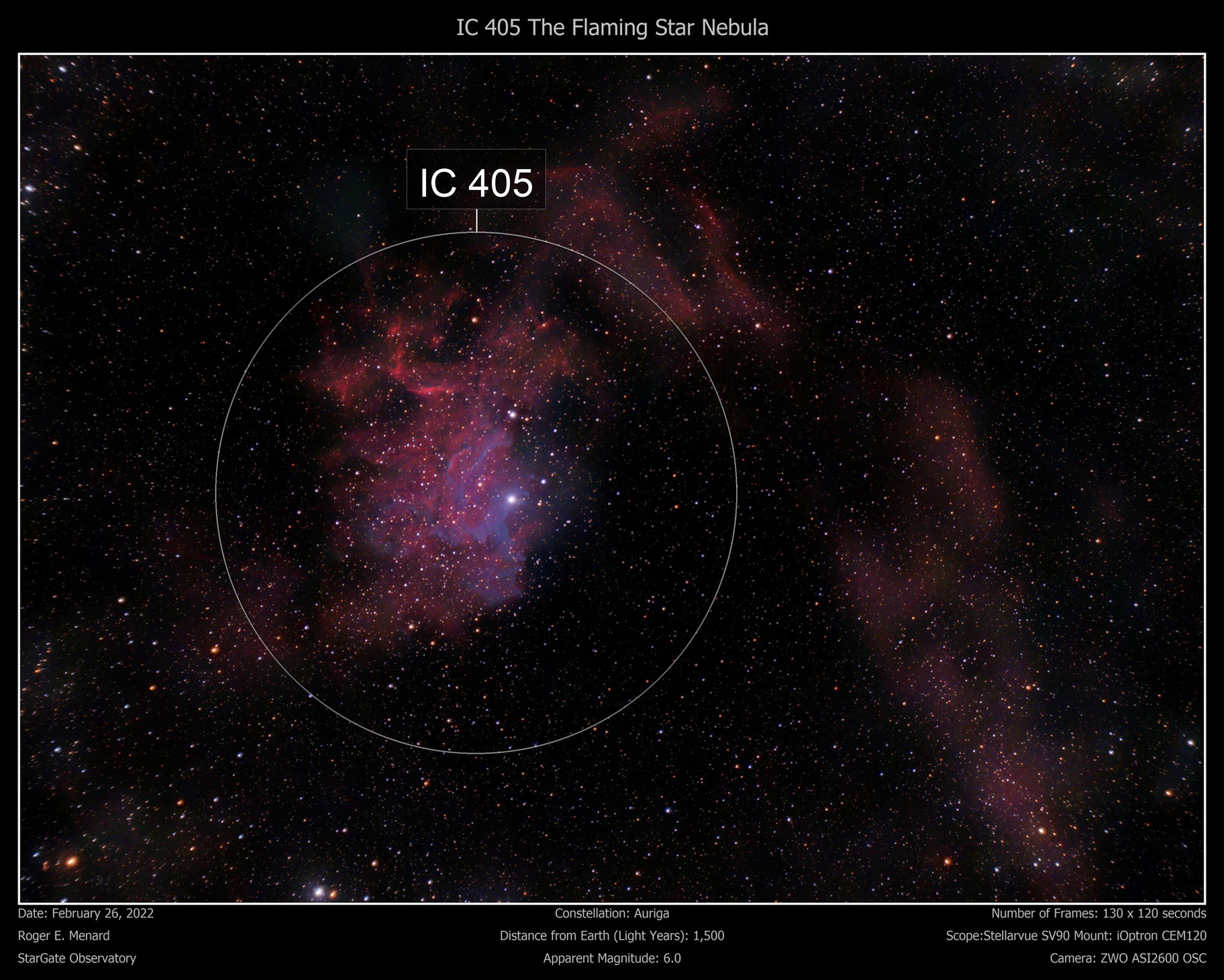
IC 405 Emission & Reflection Nebula