Caldwell 27
Common Name: Crescent Nebula
Also Known as: NGC 6888, Sharpless 105 (Sh2-105), Euro Sign Nebula
Object Type: Emission Nebula
Constellation: Cygnus
Distance from Earth: 5,000 Light years
Apparent Magnitude: 7.4
Coordinates: RA 20H 12M 7S DEC 38deg 21min 3sec
Actual Size: 25 light years in diameter
Apparent Dimensions: 18 arc-minutes x 12 arc-minutes
Discovered by: It was discovered by William Herschel in 1792.
Description: The Crescent Nebula (also known as NGC 6888, Caldwell 27, Sharpless 105) is an emission nebula in the constellation Cygnus,
about 5000 light-years away from Earth.
It is formed by the fast stellar wind from the Wolf-Rayet star WR 136 (HD 192163) colliding with and energizing the slower moving wind ejected by the star when
it became a red giant around 250,000 to 400,000 years ago.
The result of the collision is a shell and two shock waves, one moving outward and one moving inward.
The star is shedding its outer envelope in a strong stellar wind, ejecting the equivalent of the Sun’s mass every 10,000 years. The nebula’s complex structures are likely the result of this strong wind interacting with material ejected in an earlier phase.
Burning fuel at a prodigious rate and near the end of its stellar life this star should ultimately go out with a bang in a spectacular supernova explosion. Found in the nebula rich constellation Cygnus, NGC 6888 is about 5,000 light-years away.
The inward moving shock wave heats the stellar wind to X-ray-emitting temperatures.
It is a rather small object located about 2 degrees SW of Sadr.
Click Below Image(s) for Full Size:
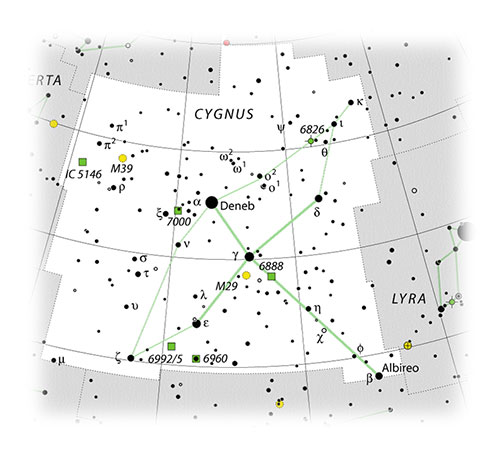
While considered bright by astronomical imaging standards, visually it is relatively faint.
For most telescopes it requires a UHC or OIII filter to see.
Under favorable circumstances a telescope as small as 8 cm (with filter) can see its nebulosity.
Larger telescopes (20 cm or more) reveal the crescent or a Euro sign shape which makes some to call it the "Euro sign nebula".
NGC 6888 is best seen in the smmer months.
Platesolve
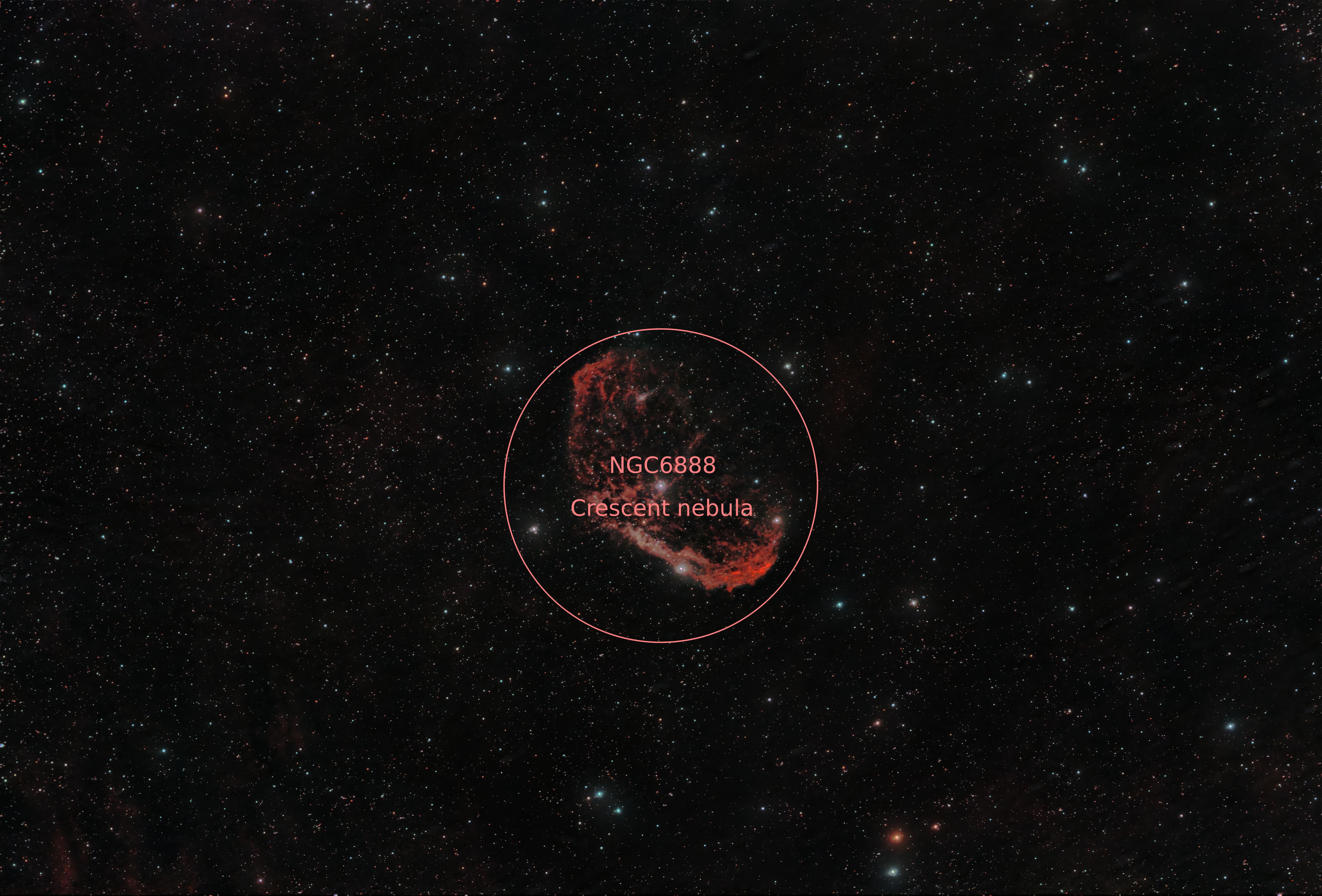
NGC 6888 Nebula

Imaging Details
Click to Return to Home Page