Caldwell 21
Also Known as: NGC 4449, UGC 7592
Object Type: Irregular Magellanic type galaxy
Constellation: Canes Venatici
Distance from Earth: 13.8 million light yeas
Apparent Magnitude: 10.0
Coordinates: RA 12H 28M 11.9S DEC 44 deg 05 min 40 sec
Actual Size: 20,000 light years in diameter
Apparent Dimensions: 6.2 arc-minutes x 4.4 arc-minutes
Discovered by: NGC 4449 was discovered by William Herschel in 1788.
Description: NGC 4449 is part of the M94 Group or Canes Venatici I Group that is relatively close to the Local Group hosting our Milky Way galaxy.
This galaxy is similar in nature to the Milky Way's satellite galaxy, the Large Magellanic Cloud (LMC), though it is not as bright nor as large.
NGC 4449 has a general bar shape, also characteristic of the LMC, with scattered young blue star clusters.
Unlike the Large Magellanic Cloud, however, NGC 4449 is considered a starburst galaxy due to its high rate of star formation
(twice the one of the LMC) and includes several massive and young star clusters, one of them in the galaxy's center.
NGC 4449 is surrounded by a large envelope of neutral hydrogen that extends over an area of 75 arc minutes (14 times larger than the optical diameter of the galaxy). The envelope shows distortions and irregularities likely caused by interactions with nearby galaxies.
Interactions with nearby galaxies are thought to have influenced star formation in NGC 4449 and, in fact, in 2012 two small galaxies have been discovered interacting with this galaxy:
a very low surface brightness disrupted dwarf spheroidal with the same stellar mass as NGC 4449's halo but with a ratio of dark matter to stellar matter between 5 and 10 times that of
NGC 4449 and a highly flattened globular cluster with two tails of young stars that may be the nucleus of a gas-rich galaxy.
Both satellites have apparently been disrupted by NGC 4449 and are now being absorbed by it.
In the dusty pink areas, brand new stars are flaring into life. Star formation activity is so widespread and intense here that astronomers refer to it as a starburst.
While starbursts are typically confined to the central, more densely packed regions of galaxies, star-forming activity in NGC 4449 reaches all the way out to the galaxy’s edge.
The starburst may have been spurred by interactions with another galaxy, or perhaps several. Since it is close enough to be observed in great detail, NGC 4449 provides the opportunity to investigate the processes that may have shaped galaxies in the early universe.
The bluish-white areas are populated by vibrant, young, massive stars. These high-mass stars are doomed to live short lives since they burn through their nuclear fuel so quickly.
Once they run out of fuel, they will end their lives in violent explosions. Medium-mass stars like our Sun can expect lifetimes of roughly 10 billion years and go out much less dramatically, gradually puffing away their outer shells of gas into a beautiful nebula.
Click Below Image(s) for Full Size:
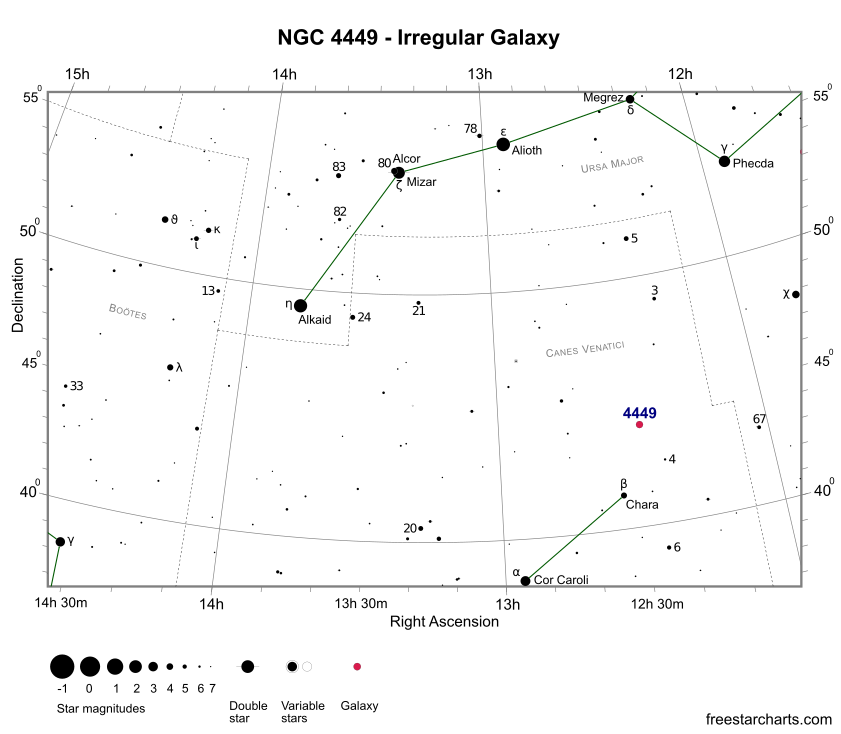
NGC 4449 is located 3 degrees northwest of Chara. It has a high surface brightness and therefore, under dark skies, can be spotted with 7x50 or 10x50 binoculars.
With a magnitude of 9.6, it is fairly easy to spot in a telescope, and in a large telescope it’s a rewarding object, exhibiting a complex pattern of bright knots.
It is best viewed in late spring from the Northern Hemisphere. Southern Hemisphere observers can find it low above the northern horizon in the autumn.
Platesolve
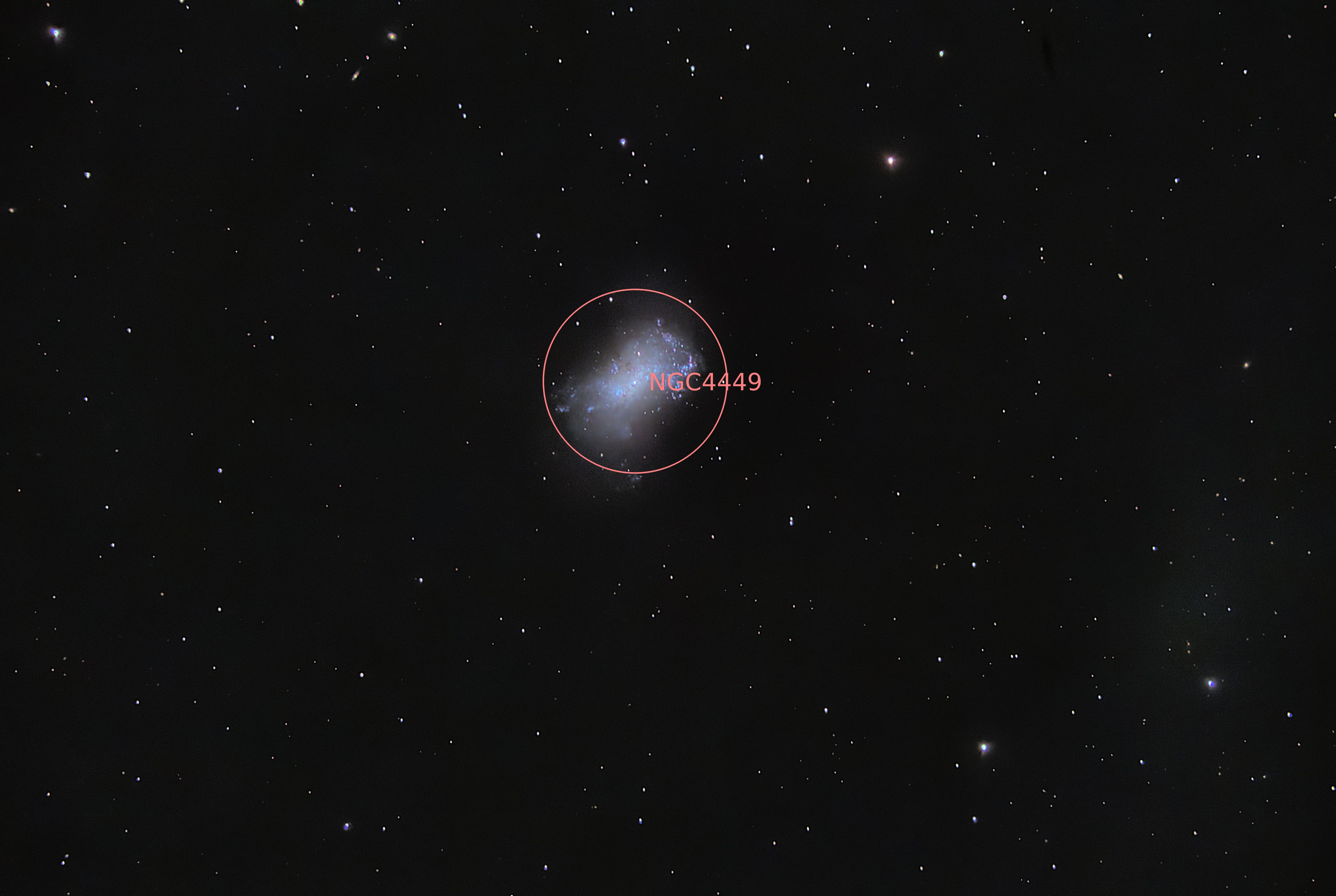
NGC 4449 Galaxy

Imaging Details
Click to Return to Home Page