Caldwell 20
Common Name: North American Nebula
Also Known as: NGC 7000, Sharpless 117 (Sh2-117)
Object Type: Emission Nebula
Constellation: Cygnus
Distance from Earth: 2,590 light years
Apparent Magnitude: 4.0
Coordinates: RA 20H 59M 17.1S DEC 44 deg 31 min 44 sec
Actual Size: 140,000 light years in diameter
Apparent Dimensions: 120 arc-minutes x 100 arc-minutes
Discovered by: On October 24, 1786, William Herschel observing from Slough, England, noted a “faint milky nebulosity scattered over this space,
in some places pretty bright.”
The most prominent region was catalogued by his son John Herschel on August 21, 1829. It was listed in the New General Catalogue as NGC 7000, where it is described as a "faint,
most extremely large, diffuse nebulosity.”
Description: The North America Nebula is an emission nebula in the constellation Cygnus, close to Deneb.
The identity of the star that ionizes the nebula’s hydrogen was long uncertain and suspected by some to be Deneb, as the North America Nebula lies only 3 degrees east of the bright star.
However, it is the hot, massive 6th magnitude binary star HD 199579 that is responsible for setting the nebula aglow. The star is also known as Miro’s Diamond.
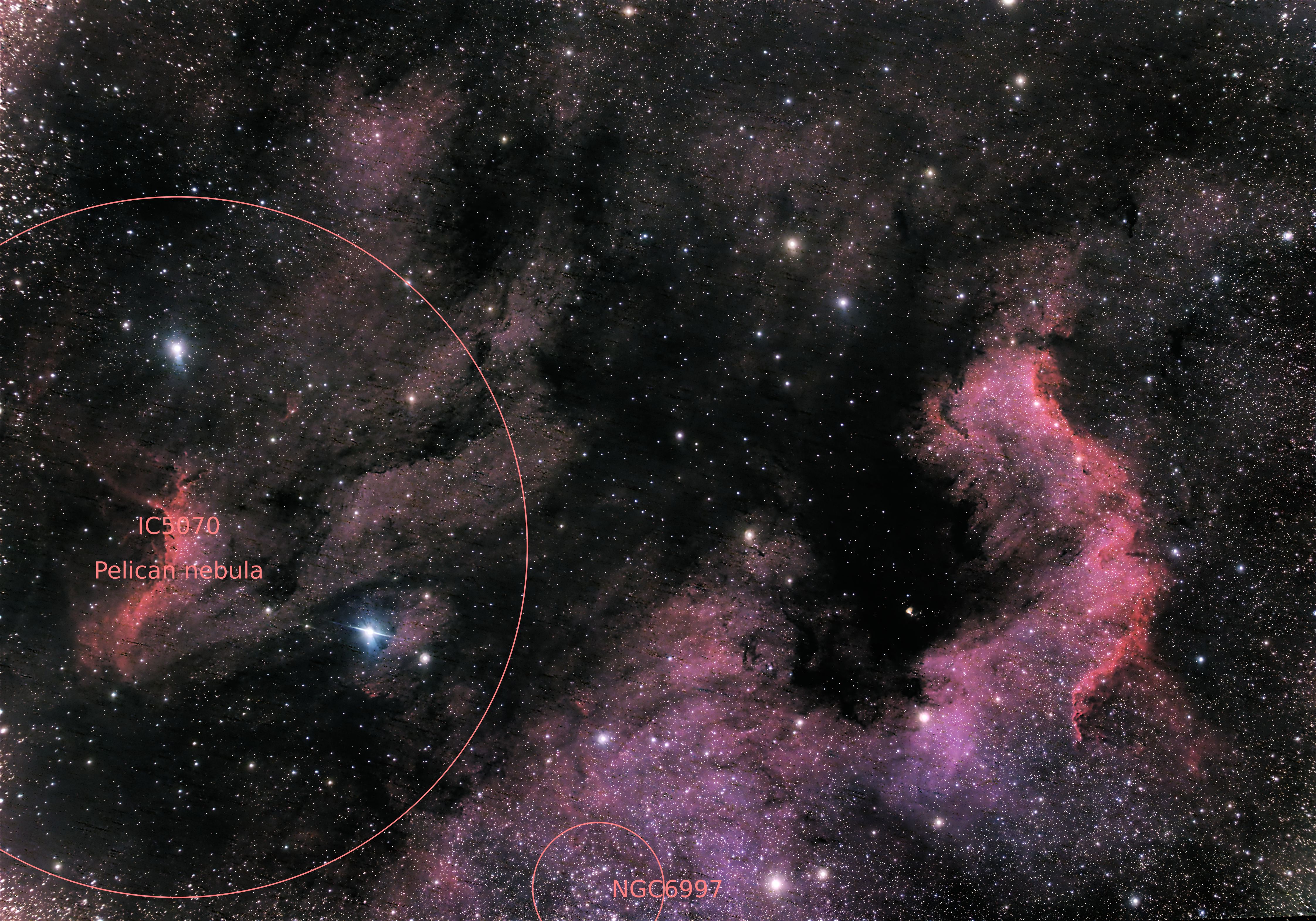
The North America Nebula is part of the same H II region as its smaller neighbor, the Pelican Nebula (IC 5070). The two nebulae are separated by a molecular cloud of dark obscuring dust. They are both located in the Orion Arm of the Milky Way.
The Gaia astrometry spacecraft measured the distances to 395 stars lying within the HII region, giving the North America and Pelican nebulae a distance of 2,590 light years (795±25 parsecs).
The entire HII region Sh2-117 is estimated to be 140 light years across, and the North America nebula stretches 90 light years north to south.
The shape of the nebula resembles that of the continent of North America, complete with a prominent Gulf of Mexico.
Its shape and reddish color (hydrogen Hα emission line) show up only in photographs of the area.
The portion of the nebula resembling Mexico and Central America is known as the Cygnus Wall. This region exhibits the most concentrated star formation.
At optical wavelengths, the North America Nebula and the Pelican Nebula (IC 5070) appear distinct as they are separated by the silhouette of the dark band of interstellar dust L935.
The dark cloud is however transparent to radio waves and infrared radiation, and these wavelengths reveal the central regions of Sh2-117 that are not visible to an ordinary telescope,
including many highly luminous stars.
Click Below Image(s) for Full Size:
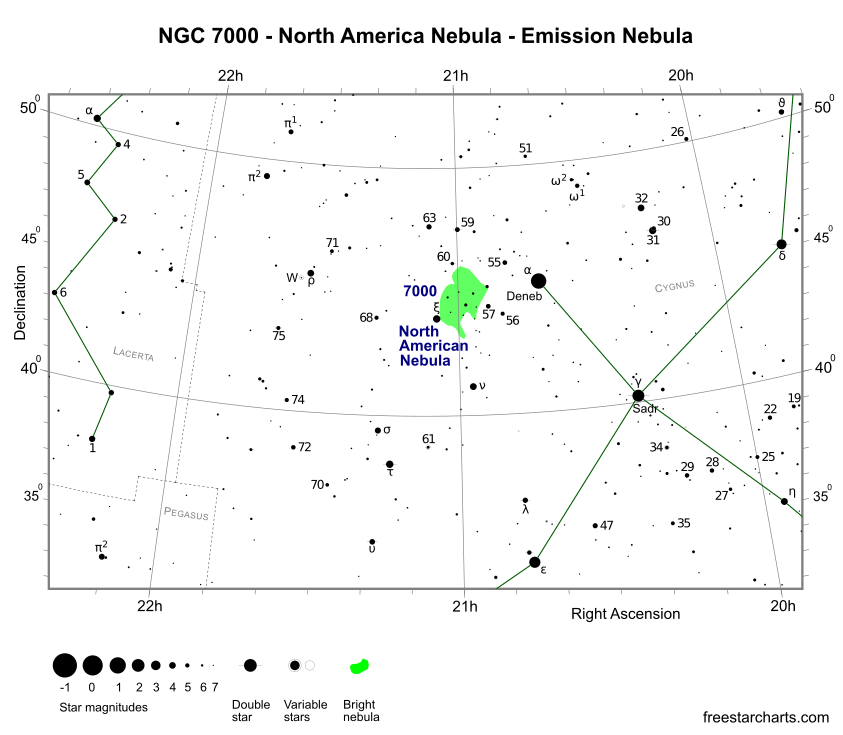
The North America Nebula covers a region more than ten times the area of the full moon, but its surface brightness is low, so normally it cannot be seen with the unaided eye.
Binoculars and telescopes with large fields of view (approximately 3°) will show it as a foggy patch of light under sufficiently dark skies.
However, using a UHC filter, which filters out some unwanted wavelengths of light, it can be seen without magnification under dark skies.
NGC 7000 is best observed in the summer months when Cygnus is high in the night sky
Platesolve
NGC 7000 Nebula

Imaging Details
Click to Return to Home Page