Caldwell 1
Also Known as: NGC 188
Object Type: Open Cluster
Constellation: Cepheus
Distance from Earth: 5,400 Light years
Apparent Magnitude: 10.0
Coordinates: RA 00H 48M 26S DEC 65deg 15.3min 0sec
Actual Size: 23.6 light years in diameter
Apparent Dimensions: 15 arc-minutes x 15 arc-minutes
Discovered by: NGC 188 was discovered by John Herschel in 1825.
Description: NGC 188 is an open cluster, a group of stars that were all formed from the same large cloud of gas and are therefore all roughly the same age.
Many open clusters, like NGC 188, are made up of stars that aren’t very close together and therefore have only a loose gravitational connection.
For this reason, these stars have the tendency to slowly drift apart over millions of years. But NGC 188 is different.
One of the oldest open clusters known, it sits far enough away from our galaxy’s core that it hasn’t yet been ripped apart by the galaxy’s gravitational influences.
NGC 188 is estimated to be at least 6.8 billion years old.
NGC 188 is very close to the North Celestial Pole, under five degrees away, and in the constellation of Cepheus at an estimated 5,400 light-years' distance,
this puts it slightly above the Milky Way's disc and further from the center of the galaxy than the Sun.
Click Below Image(s) for Full Size:
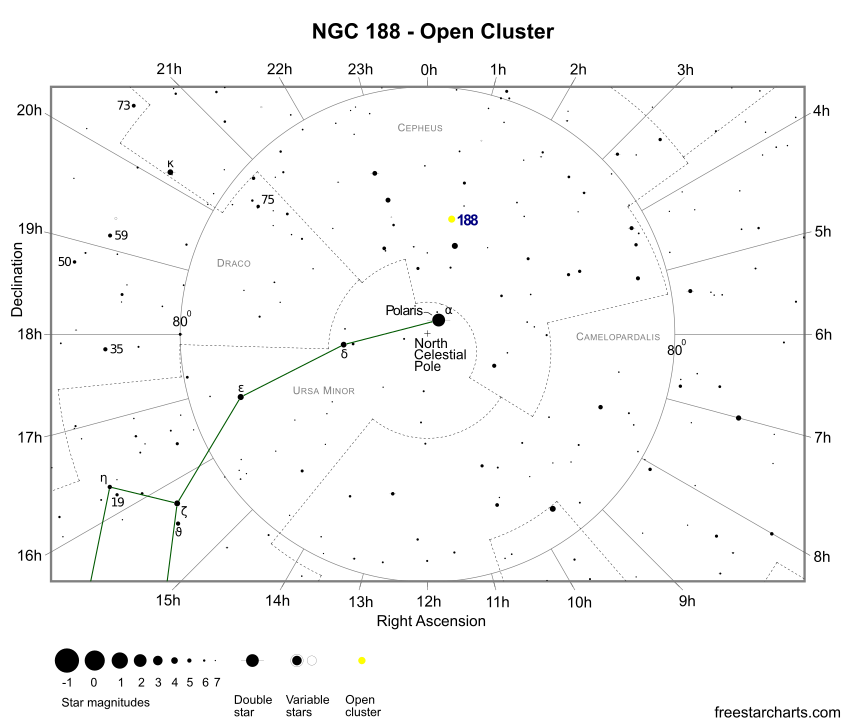
NGC 188 is located in the constellation Cepheus and is circumpolar, meaning it is so close to the North Celestial Pole that it is above the horizon at all times from anywhere in the Northern Hemisphere.
Because of this, NGC 188 is easily viewed year-round for northern observers.
It is not far from Polaris, the North Star, located at the end of the “handle” of the Little Dipper.
Use a telescope to find the soft, dim glow from this cluster of stars, and on especially dark nights, you may be able to see some of the brightest of the bunch resolved within.
Platesolve
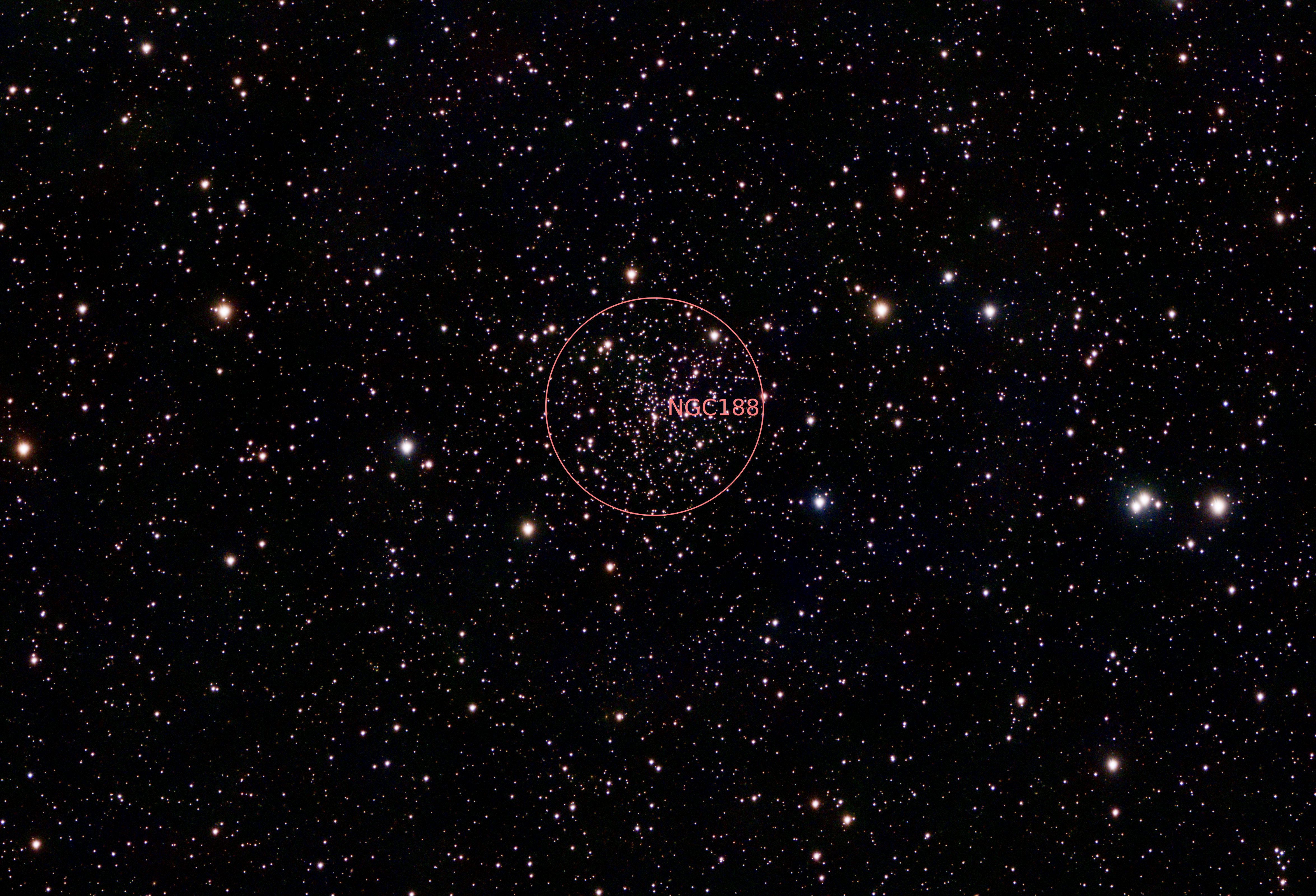
NGC 188 Cluster

Imaging Details
Click to Return to Home Page