Caldwell 19
Common Name: Cocoon Nebula
Also Known as: IC 5146, Sharpless 2-125 (Sh2-125).
Object Type: Emission Nebula
Constellation: Cygnus
Distance from Earth: 2,500 light years
Apparent Magnitude: 7.2
Coordinates: RA 21H 53M 28.7S DEC 47 deg 16 min 01 sec
Actual Size: 15 light years light years in diameter
Apparent Dimensions: 12 arc-minutes
Discovered by: IC 5146 was discovered by Edward Barnard in 1893 and Max Wolf in 1894.
Description: The Cocoon Nebula is located in a crowded field of stars spanning approximately 2 degrees.
IC 5146 is a compact star-forming region, with a long trail of obscuring interstellar dust clouds.
The Cocoon Nebula is illuminated by BD +46°3474, a hot young main sequence star of the spectral type B0 V or B1 V. The star is enveloped in a molecular cloud at the eastern end of a dark lane spanning 2 degrees. It was reported to be a close binary system and may even be a multiple star system.
A 2002 study identified it as the most massive member of IC 5146. The star has a mass of 14 ± 4 solar masses and is believed to be only 100,000 years old.
The NGC description refers to IC 5146 (also known as Collinder 470) as a “cluster of 9.5 magnitude stars involved in a bright and dark nebula”.
The shape of the Cocoon Nebula has been explained as the result of BD +46°3474 having formed near the surface of the cloud and carved a cavity out of which nebular material is flowing in our direction.
The western part of the nebula is intersected by a dark lane that winds around the young cluster. The dark nebula is catalogued as Barnard 168 (B168).
It stretches from the Cocoon Nebula in the direction of the bright open cluster Messier 39.
The cluster is about 4,000 light years away, and the central star that lights it formed about 100,000 years ago.
Click Below Image(s) for Full Size:
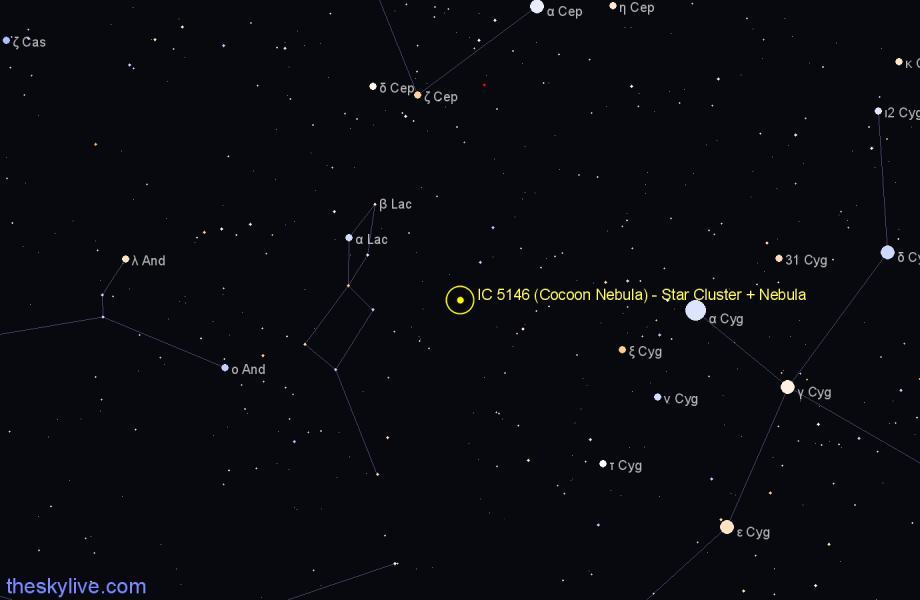
The Cocoon Nebula lies in the same area of the sky as Deneb and the open cluster Messier 39. Deneb is easily identified as the bright star at the top of the Northern Cross, a bright asterism that outlines the body of the celestial Swan.
When viewing IC 5146, dark nebula Barnard 168 (B168) is an inseparable part of the experience, forming a dark lane that surrounds the cluster and projects westward forming the appearance
of a trail behind the Cocoon.
The best time of year to observe the Cocoon Nebula and other bright deep sky objects in Cygnus is during the month of September, when the constellation is high overhead in the evening sky.
Platesolve
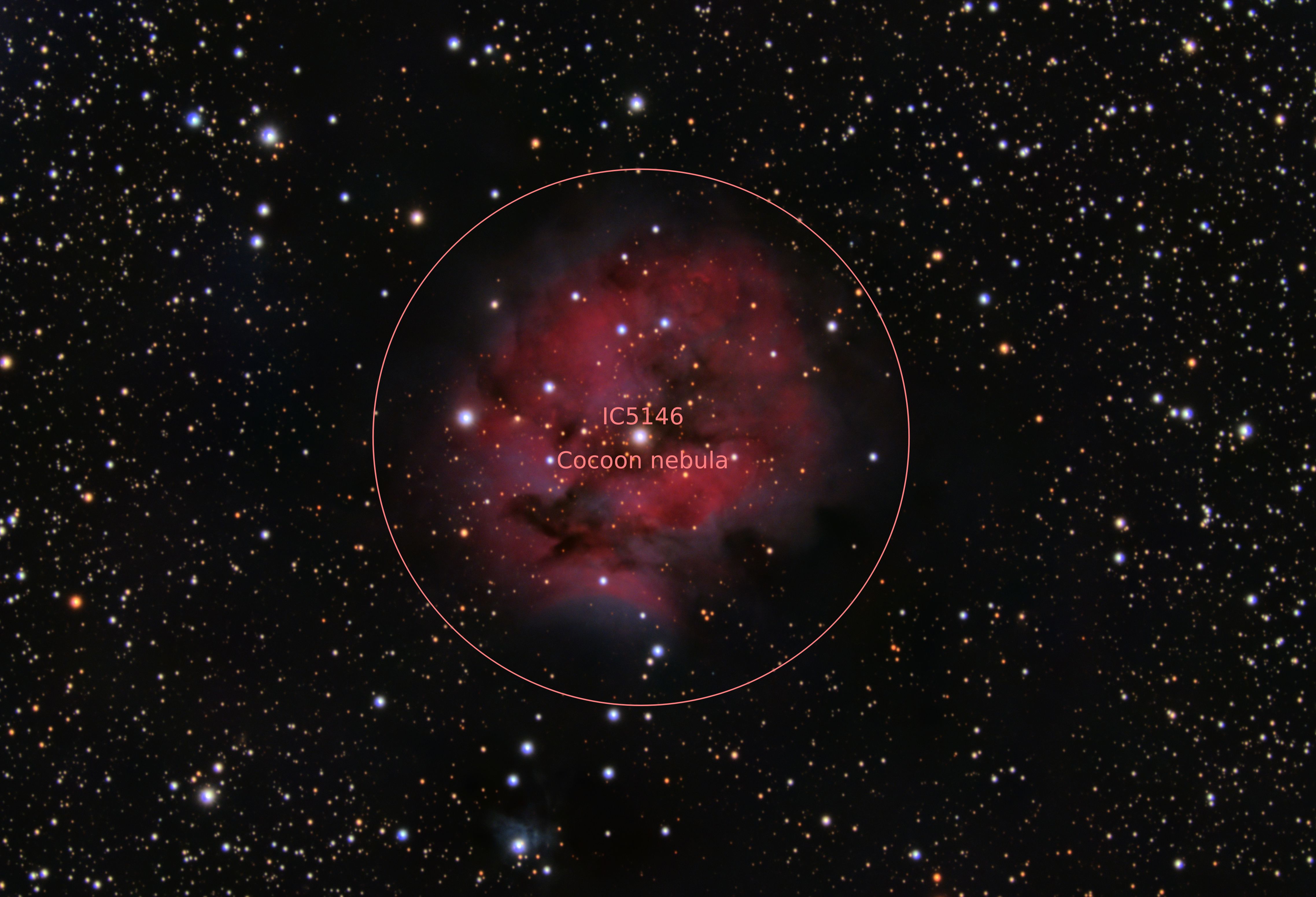
IC 5146 Nebula

Imaging Details
Click to Return to Home Page