Caldwell 15
Common Name: Blinking Planetary
Also Known as: NGC 6826
Object Type: Planetary Nebula
Constellation: Cygnus
Distance from Earth: 2,200 light years
Apparent Magnitude: 8.8
Coordinates: RA 19H 44M 48.2S DEC 50 deg 31 min 30.3 sec
Actual Size: 0.5 light years in diameter.
Apparent Dimensions: 27 arc-seconds x 24 arc-seconds
Discovered by: The Blinking Planetary Nebula was discovered by the German-born British astronomer William Herschel on September 6, 1793.
Description: When observers look directly at NGC 6826 through a small telescope, they typically see only the nebula’s sparkling-white central star.
However, by averting one’s gaze, glancing away from the central star, the nebula's bulbous dust clouds come into view. This optical trickery earned this planetary nebula the name the "Blinking Planetary.”
Most planetary nebulae exhibit this type of behavior but with NGC 6826 it's particularly obvious.
The central star of the Blinking Planetary Nebula has the stellar classification O6fp, indicating a very hot blue star.
It is one of the brightest central stars detected in a planetary nebula.
NGC 6826 is surrounded by a large faint halo that stretches beyond the brighter central ring. The halo consists of material ejected by the central star before the main nebula was formed.
Like all planetary nebulae, it formed when an aging red giant star reached the end of its life and expelled its outer gaseous envelope into space. The cloud of gas and dust is illuminated by the hot stellar remnant, which will eventually cool and fade as a dense white dwarf.
The Blinking Planetary’s bright, white remnant star – known as a white dwarf – is surrounded by a greenish orb of gas and dust, the outer layers of the burned-out star that jettisoned into space.
A distinctive feature of this nebula are the two bright patches on either side.
They appear to be relatively young, moving outwards at supersonic speeds.
The Blinking Planetary Nebula lies in the region of the Northern Cross, one of the most familiar asterisms in the northern sky.
Like all planetary nebulae, it formed when an aging red giant star reached the end of its life and expelled its outer gaseous envelope into space.
The cloud of gas and dust is illuminated by the hot stellar remnant, which will eventually cool and fade as a dense white dwarf.
Click Below Image(s) for Full Size:
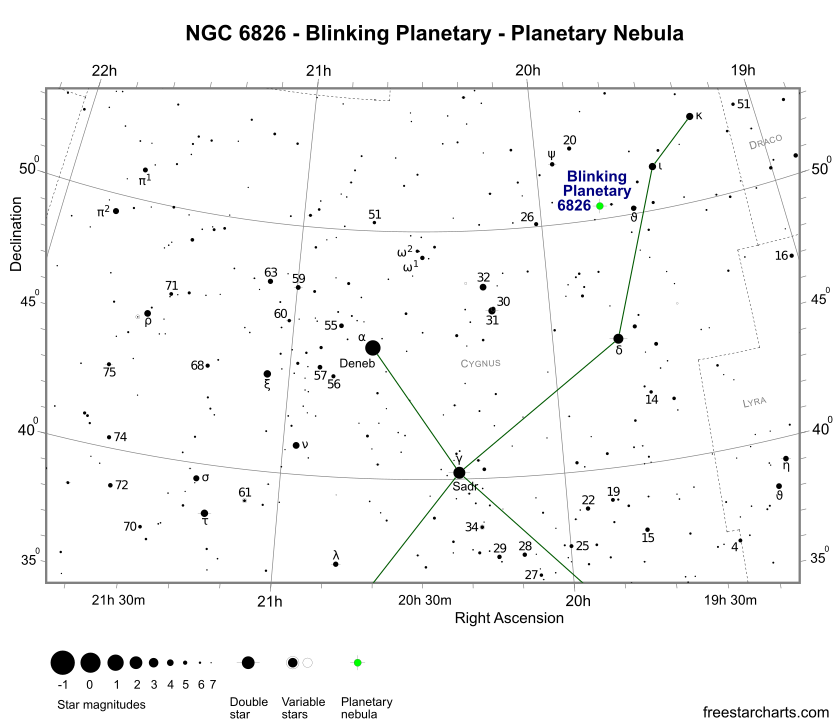
The nebula is found in the constellation Cygnus, and it is best observed during warm summer nights in the Northern Hemisphere.
It will appear low in the northern sky for Southern Hemisphere observers during the winter.
NGC 6826 can be seen with popular 7x50 or 10x50 binoculars, although it appears only like a dim star. Through a small scope NGC 6826 appears evenly illuminated but small.
The best time of the year to observe the Blinking Planetary Nebula and other deep sky objects in Cygnus is during the month of September, when the constellation is high above the horizon in the evening.
Platesolve
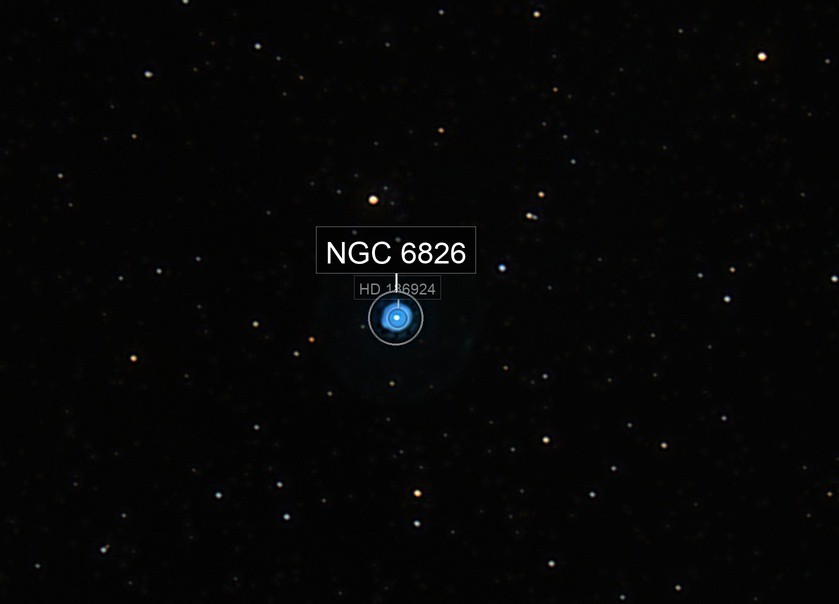
NGC 6826 Planetary Nebula

Imaging Details
Click to Return to Home Page