Caldwell 13
Common Name: Owl Cluster
Also Known as: NGC 457, Dragonfly Cluster, E.T. Cluster, Kachina Doll Cluster, Phi Cassiopeiae Cluster.
Object Type: Open Cluster
Constellation: Cassiopeia
Distance from Earth: 7,922 Light years
Apparent Magnitude: 6.4
Coordinates: RA 01H 19M 32.6S DEC 58 deg 17 min 27 sec
Actual Size: 30 light years in diameter
Apparent Dimensions: 20 arc-minutes
Discovered by: NGC 457 discovered by William Herschel on August 18, 1780, with a 6.2 inch reflector telescope.
Description: NGC 457 is the brightest open cluster in Cassiopeia and one of the finest objects of its type in the northern sky.
The brightest cluster stars are arranged in prominent lines and curves that resemble an Owl shape, hence the popular name "The Owl Cluster". NGC 457 consists of about 60 stars in a field of about 150 stars. It has an estimated age of 21 million years.
Since not included in the Messier catalogue, NGC 457 is often overlooked and not so well known as other bright clusters. However, this beautiful group of stars is one of the best open clusters in the northern sky.
Two bright stars Phi Cassiopeiae (magnitude 5 and spectral type F0) and HD 7902 (magnitude 7) can be imagined as eyes.
It is not yet clear if Phi Cassiopeiae is a member of the cluster, and if it is, then it would be one of the brightest stars known, surpassing Rigel in luminosity.
For comparison, the Sun at the same distance as Phi Cassiopeiae would shine at just 17.3 magnitude. The next brightest star is the red supergiant variable star V466 Cassiopeiae.
The cluster features a rich field of about 150 stars of magnitude 9-13. About 60 stars have been identified as true members of the cluster.
Click Below Image(s) for Full Size:
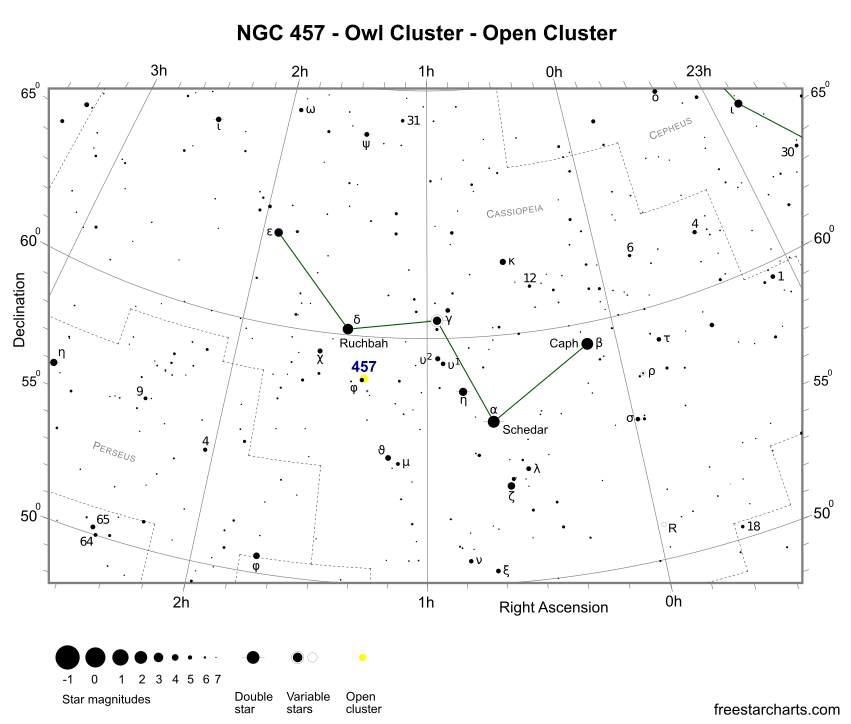
At magnitude +6.4, it's just beyond naked-eye visibility but easily seen with binoculars and a beautiful sight through telescopes.
Platesolve
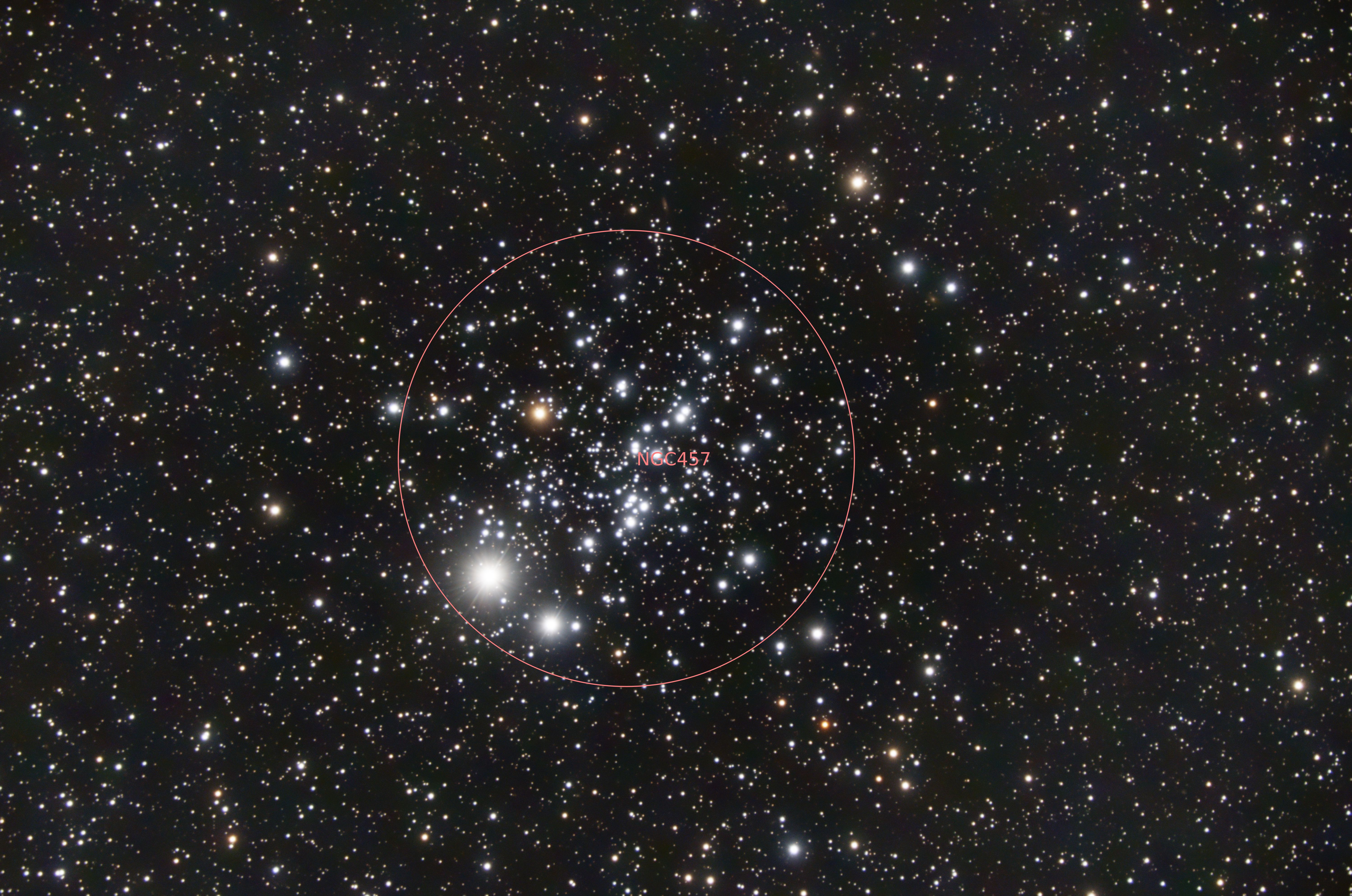
NGC 457 Cluster

Imaging Details
Click to Return to Home Page